
You got a night guard to stop pain, not start it. So, waking up with a sore, aching jaw can feel incredibly frustrating—and you're right to be concerned. This is a clear signal that something isn’t working correctly, and it’s a problem we help patients solve all the time here at Seven Oaks Dentistry & Sleep Medicine in Wesley Chapel, FL.
Why Your Night Guard Might Be Causing Jaw Pain
While a night guard should bring relief, it can sometimes introduce new issues if it's not a perfect fit for your unique bite. This is especially common with generic "boil-and-bite" guards that can’t account for the intricate nuances of your jaw alignment.
Many people turn to night guards to combat bruxism—the involuntary grinding and clenching of teeth—which affects nearly 8% of adults worldwide. But when the guard doesn't fit right, it can worsen an undiagnosed TMJ disorder, a condition impacting about 12% of the U.S. population. While custom-fit guards from a dentist can successfully help up to 70% of users, a poorly fitting one can force your jaw into an unnatural position all night long. You can explore more about how a proper guard should work by reading these insights on teeth grinding and jaw pain.
Your Partner in Whole-Body Health
At Seven Oaks Dentistry & Sleep Medicine, we see things differently. As a proudly independent, family-owned practice, we believe your mouth is the gateway to your overall well-being. This philosophy of “healing through the mouth” is at the very core of what we do. Jaw pain isn’t just an inconvenience; it’s a signal from your body that an imbalance in your oral system is affecting everything from your sleep to your daily comfort.
With over 30 years of dedicated experience, Dr. Lee Daniels understands that your bite is a complex system. He looks beyond the teeth to diagnose the root cause of your pain, ensuring your treatment supports total body health.
When a night guard causes this kind of muscular discomfort, looking into effective muscle pain relief strategies can offer some temporary help. But that's a band-aid, not a solution. It’s time to find out what’s really going on with a professional evaluation.
As one of the only private practice dentists in the Wesley Chapel and North Tampa area, we provide a level of personalized attention and continuity of care that is becoming increasingly rare. We’re here to listen, diagnose the problem accurately, and create a solution that brings you lasting relief. Your comfort and complete health are what matter most.
The Most Common Reasons a Night Guard Causes Discomfort
A night guard is supposed to be a tool for relief, so waking up with a sore jaw can be confusing and frustrating. It’s a lot like wearing a pair of shoes that don't quite fit; they might look right, but they'll cause strain and pain with every step. The same logic applies to your mouth.
When patients in Wesley Chapel come to us with jaw pain after wearing a night guard, it almost always signals a mismatch between the appliance and their unique bite. Let's dig into the common reasons your guard might be causing more harm than good.
The Problem with an Improper Fit
The number one culprit behind night guard pain is a poor fit. This is especially common with over-the-counter "boil-and-bite" guards, but even an old custom guard can lose its shape over time. If it doesn’t seat perfectly, your jaw muscles end up working all night to keep it in place.
That constant, subtle effort adds up, leading to muscle fatigue and a stiff, sore jaw by morning. A professionally made appliance should feel snug and secure, letting your muscles finally relax instead of pulling an all-night shift.
How a Night Guard Can Alter Your Bite
Pain can also come from a guard that throws off your natural bite. If the appliance is too thick or has "high spots," it forces your teeth to connect in an awkward, unnatural position. This imbalance puts a huge amount of stress on specific teeth and, more critically, on your temporomandibular joints (TMJ).
A night guard shouldn't just be a barrier—it should be a therapeutic device that promotes a balanced, comfortable bite. When it throws your alignment off, it can aggravate the very symptoms it's meant to prevent.
This is exactly why a professional evaluation from an experienced dentist is so critical. At Seven Oaks Dentistry & Sleep Medicine, we make sure any appliance we create supports a healthy, stable bite, which is central to our philosophy of promoting whole-body wellness through complete oral health.
The Wrong Guard for Your Needs
Not all night guards are the same, and using the wrong kind for your specific issue can actually make things worse. Some people, for instance, clench even harder on soft, flexible guards because the material gives their jaw something to "chew" on, inadvertently strengthening the clenching muscles.
- Soft, Chewy Guards: Can sometimes act like a "toy" for your jaw, encouraging more clenching and grinding activity rather than discouraging it.
- Hard, Custom Guards: A rigid, professionally-made guard provides a slick, stable surface that helps muscles disengage and protects the delicate jaw joint.
For many people battling bruxism, a hard acrylic guard is the clear winner for reducing muscle strain. To learn more about the condition itself, our guide on how to stop teeth grinding at night offers some great insights. Ultimately, an expert like Dr. Daniels can determine which type is best suited to your jaw without causing any extra pain.
That new night guard was supposed to be the solution to your jaw pain, not the cause of it. So why are you waking up feeling worse than before? While it’s easy to blame the guard itself, the real story is often more complex. Your jaw pain is frequently tied to deeper issues like stress and even your quality of sleep.
At Seven Oaks Dentistry & Sleep Medicine, we see this all the time. Our entire approach is built on the idea of healing through the mouth for total-body health, and the jaw is a perfect example of this connection.
Many of our patients in Wesley Chapel are surprised when we explain how the stress from their day follows them into the night. When you’re stressed, your body enters a “fight or flight” mode, causing muscles all over your body to tense up—including your jaw. This often leads to bruxism, an intense, unconscious grinding and clenching that can exert hundreds of pounds of force. A night guard does a great job of protecting your teeth from wear and tear, but it doesn’t actually stop those powerful jaw muscles from working overtime.
The Overlooked Role of Stress in Jaw Pain
Stress isn't just a feeling; it has a very real, physical effect on the body, and the jaw is often ground zero. The recent global health crisis gave us a crystal-clear look at this link on a massive scale.
One analysis showed just how much the pandemic dialed up jaw-related issues. During that period, reports of orofacial pain shot up from 35% to 47%. What's even more revealing is that daytime clenching increased by 32%, and nighttime grinding skyrocketed from 10% to 36%. The severity of symptoms also jumped by an average of 15%. It’s a powerful reminder that high stress often leads directly to bruxism. You can read more about these findings on stress and jaw clenching.
When Grinding Is a Sign of Something More
While stress is a huge piece of the puzzle, there’s another critical factor that often gets missed: your sleep quality. For some people, intense nighttime grinding isn't just a stress response. It’s the body’s desperate attempt to deal with a blocked airway, which is a primary red flag for undiagnosed obstructive sleep apnea (OSA).
When the airway collapses, the brain signals the jaw to grind and shift forward in an attempt to reopen it and restore airflow. In these cases, a standard night guard does nothing to address the root cause and may even worsen the condition.
This is exactly why our Wesley Chapel practice integrates sleep medicine so deeply into our dental care. For many of our patients across the North Tampa area, a night guard is just one small part of a much bigger health picture. We believe in looking at everything—from your bite and jaw alignment to your breathing patterns—to find a solution that not only brings you comfort but genuinely improves your overall health. Our experienced team is uniquely trained to figure out if your jaw pain is a dental issue, a sleep disorder, or a mix of both.
How We Diagnose the Real Cause of Your Jaw Pain
A little bit of discomfort for the first few days can be perfectly normal as your mouth gets used to a new night guard. But if you’re dealing with severe or persistent jaw pain after wearing a night guard, or you’re noticing new clicking, popping, or a locked-jaw feeling, that’s a clear sign something isn’t right. It’s your body’s way of telling you it’s time for a professional look.
At Seven Oaks Dentistry & Sleep Medicine, we don’t do guesswork. As a private practice that puts patients first, our entire diagnostic process is built to find the true source of your discomfort, not just cover up the symptoms. We look at the bigger picture to figure out why you’re in pain.
A Comprehensive, Hands-On Examination
Your path to relief starts with a one-on-one consultation with Dr. Daniels right here in our Wesley Chapel office. With over 30 years of experience, he knows that jaw pain is rarely just about the teeth. The evaluation is a meticulous, hands-on process.
Dr. Daniels will carefully examine:
- Your Jaw Joints (TMJ): He’ll gently feel the joints as you open and close your mouth, checking for any tenderness, clicking sounds, or limited movement.
- Your Facial Muscles: The muscles you use for chewing can get incredibly strained and sore. He will assess these areas for tension and painful trigger points.
- Your Bite (Occlusion): We’ll analyze how your top and bottom teeth meet to spot any high spots or imbalances that could be forcing your jaw into an unnatural position.
Beyond a simple night guard issue, nagging jaw pain can often be a symptom of conditions like temporomandibular joint (TMJ) disorder. Our comprehensive approach helps us tell the difference between a minor fit problem and a more complex underlying condition that needs attention.
Beyond the Teeth: Whole System Health
Unlike corporate dental offices, our independently owned practice is built on a philosophy of complete health. We know that your jaw is a complex system of bones, muscles, and nerves that all need to work together in harmony.
We don’t just look at the guard; we assess the entire oral system. This approach ensures we identify the root cause of your pain, whether it’s the appliance itself, your bite alignment, or even an undiagnosed sleep issue.
This deep dive allows us to create a truly personalized treatment plan. For some people, a simple adjustment to their existing guard is all it takes. For others, we might recommend a new, custom-fit appliance designed for therapeutic relief or even other supportive therapies. Our goal is to restore comfort and function for our patients throughout the North Tampa area.
Custom-Fit Night Guards for Lasting Relief
A professionally made night guard is in a completely different league than the generic ones you buy at the drugstore. It's not just a piece of plastic—it's a therapeutic device designed just for you. Think of it as the difference between buying a suit off the rack and getting one custom-tailored.
When patients come to us with jaw pain after wearing a night guard, our process at Seven Oaks Dentistry starts with precision. We use advanced digital impressions to create an appliance that gives you a stable, comfortable bite, ensuring it actually solves the pain instead of causing more.
More Than Just a Barrier
A custom-fit guard from our Wesley Chapel office is built to do more than simply keep your teeth apart. Depending on what you need, it can work in a few different ways.
For example, a stabilization splint is made from a hard acrylic material. It creates a perfectly flat, even surface for your teeth to meet, which tells your tense jaw muscles it's okay to relax. A repositioning splint, on the other hand, gently guides your jaw into a healthier, more stable alignment to take pressure off the TMJ itself.
The flowchart below shows our clear, step-by-step diagnostic process for figuring out which solution is right for your unique situation.
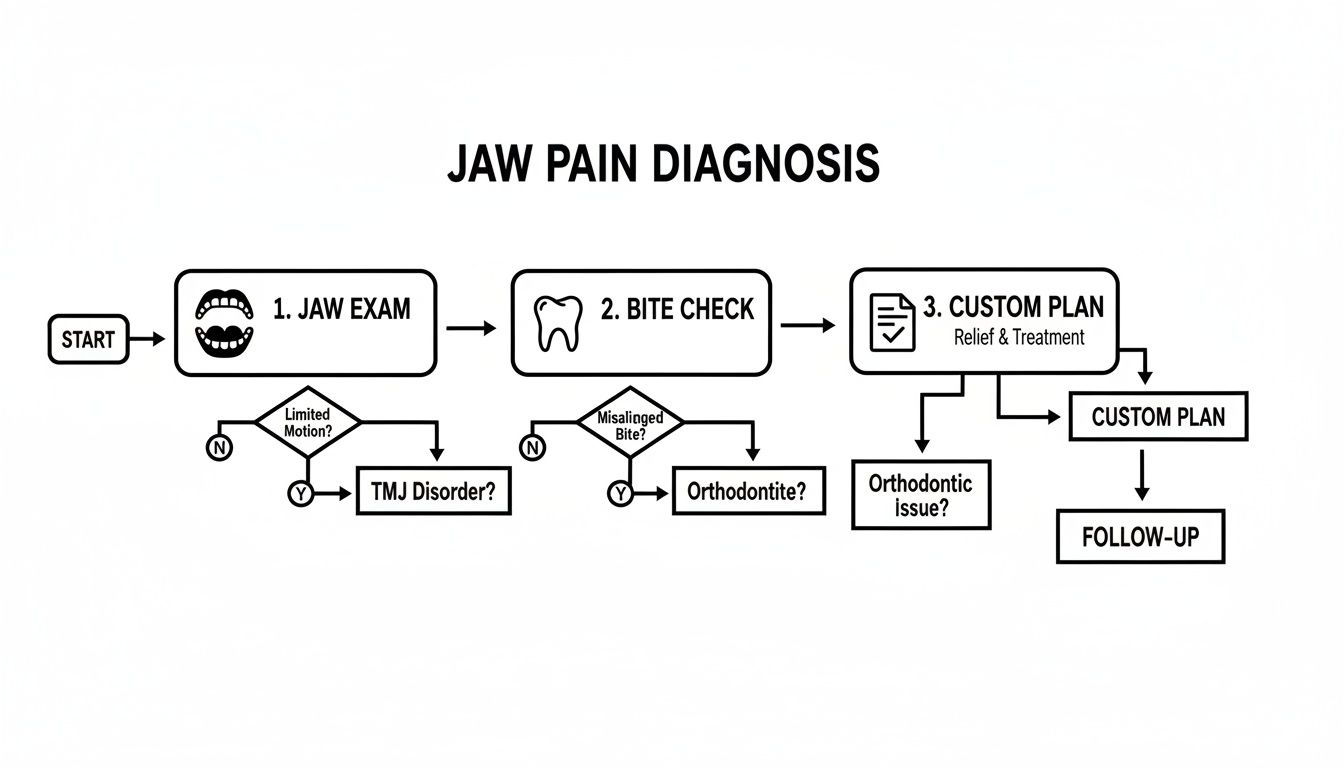
This detailed approach ensures we get to the bottom of your discomfort and create a plan that brings real, lasting relief.
Our Comprehensive Approach to Healing
This personalized strategy is a key part of our complete health philosophy. While studies show the right night guard can slash bruxism symptoms by up to 70%, a poorly fitting generic guard can make clenching worse or even mask an underlying sleep apnea issue. With TMJ disorders impacting an estimated 35 million people in the U.S., a professional diagnosis isn't just a good idea—it's critical for your long-term health.
At our private practice, a night guard is often just one piece of a bigger puzzle. True healing comes from fixing the root cause, not just putting a bandage on a symptom.
This is where our integrated care really makes a difference. If misaligned teeth are contributing to your bite problem, we might recommend Invisalign or clear aligners to build a healthier foundation first. If years of grinding have already caused wear and tear, restorative dentistry can bring back your smile’s strength and function. Sometimes, the issue is tied to breathing, which is why we also offer oral appliances to help with sleep apnea.
For our patients in Wesley Chapel and Northern Tampa, our goal isn’t just to stop the grinding. It's to get rid of your pain, restore your jaw's function for good, and support your total body health.
Schedule Your Jaw Pain Consultation in Wesley Chapel, FL
Jaw pain from a night guard is more than just an annoyance—it's a clear signal from your body that something isn’t right. Simply pushing through the discomfort isn't a solution and can often lead to bigger, more complicated issues down the road. At Seven Oaks Dentistry & Sleep Medicine, our goal is to help you find relief that’s not only comfortable but lasts.
As one of the few remaining privately owned practices here in Wesley Chapel, FL, we offer a level of dedicated, one-on-one care that’s becoming increasingly rare. With over 30 years of experience, Dr. Lee Daniels looks past the immediate symptoms to find the real source of your pain. This commitment to whole-body health—knowing that your bite and jaw are connected to your overall well-being—is the foundation of our practice.
Don’t let jaw pain disrupt your life any longer. A professional evaluation is the first step toward understanding the cause and finding a solution that works for you.
We're proud to serve individuals and families from all over Wesley Chapel and the greater North Tampa area who are looking for a different kind of dental experience. We believe in building real relationships, which means we take the time to listen, explain your options, and work with you to create a plan that fits your specific needs.
Ready to put jaw pain behind you? Contact Seven Oaks Dentistry & Sleep Medicine today to schedule your consultation. Our friendly team is here to help you get out of pain and back to feeling your best.
Frequently Asked Questions About Night Guards and Jaw Pain
Trying to navigate the world of night guards can bring up a lot of questions, especially if you start feeling unexpected discomfort. As your trusted local dentist here in Wesley Chapel, we want to give you clear, reassuring answers. We'll help you understand what's normal, what's not, and when it's time to give us a call.
Here are some of the most common questions we hear from our patients.
Is It Normal for a New Night Guard to Hurt at First?
Feeling a little something new in your mouth—a sense of slight pressure or just being aware of the appliance—is perfectly normal for the first few nights. Your mouth is simply getting used to it. However, sharp pain, muscle soreness that doesn't go away, or any discomfort that gets worse over time is not normal. That's a sign that something is wrong.
This kind of pain often points to an issue with how the guard fits or how it's affecting your bite. At Seven Oaks Dentistry & Sleep Medicine, we make sure our custom guards feel comfortable from day one, and we always schedule follow-up visits to make any tiny adjustments our patients might need.
Can an Over-the-Counter Night Guard Make TMJ Worse?
Yes, it absolutely can. Most over-the-counter "boil-and-bite" guards are made from a soft, almost chewy material. Instead of letting your jaw muscles relax, this texture can actually encourage more clenching and grinding—it’s like giving your jaw a stress toy to chew on all night.
For someone with an underlying TMJ disorder, this increased muscle activity can put serious strain on the jaw joint. This often worsens symptoms like pain, clicking, and headaches. A custom-fitted hard acrylic splint, made by an experienced dentist, is the only recommended and safe way to protect your complete oral health.
How Do I Know if My Pain Is From the Guard or Sleep Apnea?
This is a tough one to figure out on your own because the symptoms can look almost identical. Chronic morning headaches, feeling tired all day, and jaw pain are all classic signs of both a poorly fitting night guard and a potential sleep-breathing disorder.
In fact, intense teeth grinding (bruxism) is often the body’s reflexive attempt to open up an obstructed airway during sleep. Because our practice is deeply focused on both comprehensive dentistry and sleep medicine, Seven Oaks Dentistry is uniquely qualified to screen for both problems. Dr. Daniels, with his 30+ years of experience, can get to the bottom of whether your pain is a dental issue, a sleep disorder, or a mix of both, ensuring you get the right diagnosis and treatment right here in Wesley Chapel.
What Can I Do for Immediate Jaw Pain Relief at Home?
First thing's first: stop wearing the guard until you can see your dentist. To get some temporary relief at home, you can try these simple steps:
- Apply a warm compress to the sore muscles around your jaw for 10–15 minutes.
- Gently massage any tender spots you feel on your cheeks and temples.
- Stick to a soft food diet for a few days to give your jaw a much-needed break.
Also, be sure to avoid chewing gum or any tough, chewy foods. Just remember, these are temporary fixes. A professional exam is the only way to find and solve the root cause of the pain for good.
If you're experiencing jaw pain after wearing a night guard, please don't wait for it to get worse. Contact Seven Oaks Dentistry & Sleep Medicine today to schedule an appointment. We're here to provide the expert care and lasting relief you deserve. Schedule your consultation with us.
 Read Our Reviews

 October, 2026

