
If you're trying to figure out how to stop teeth grinding at night, the best place to start is simply recognizing the signs and understanding what they mean for your whole-body health. For many people here in Wesley Chapel, the first clue is waking up with a sore jaw, a dull headache, or sensitive teeth. These are all tell-tale signs of a condition called bruxism, a concern we see often at Seven Oaks Dentistry & Sleep Medicine.
Tackling this issue isn't about one single fix. It's often a combination of managing stress and getting professional dental solutions from a trusted local dentist to protect your smile and finally get a good night's sleep. As one of the only private practices in the area, we're dedicated to finding the root cause of your discomfort, connecting your mouth health to your overall wellness.
Waking Up to Jaw Pain and Headaches in Wesley Chapel
Does your day begin with a tight, aching jaw? Are those persistent, low-grade headaches just part of your morning routine now? If you live in Wesley Chapel, FL, or anywhere in the North Tampa area and this sounds a little too familiar, you're definitely not alone. These discomforts are often the very first signs of nighttime teeth grinding, a surprisingly common condition that can drag down your quality of life.
It’s easy to brush off a sore jaw as a minor thing, but it's your body's way of sending up a flare. The incredible force you generate by clenching and grinding all night can lead to a host of issues that go way beyond simple pain. This constant pressure wears down your enamel, can chip or crack your teeth, and might even damage expensive dental work like crowns and veneers. This is why comprehensive care that views the mouth as the start of whole-body health is so crucial.
More Than Just a Bad Habit: Understanding Bruxism and Whole Mouth Health
Nighttime teeth grinding, or sleep bruxism, isn't something you can just decide to stop. It happens while you're completely asleep, totally out of your control. For many, it’s tied directly to daily stress, a misaligned bite, or it can even be a symptom of a more serious issue like sleep apnea. This is exactly why a one-size-fits-all solution rarely gets the job done.
Your oral health is a window into your overall wellness. Persistent teeth grinding is a perfect example of this connection, as it often points to deeper issues related to stress, airway function, and whole-body health. Ignoring it can mean missing important health signals.
Getting to the root cause is the critical first step toward finding real relief. That’s where a comprehensive, whole-person approach to dental care makes all the difference. At Seven Oaks Dentistry & Sleep Medicine, we believe in looking at the complete picture. As a privately owned practice with a dentist who has over 30+ years of experience, we have helped countless patients from our community who have struggled with this exact problem.
Finding Local, Experienced Care in Wesley Chapel
Our commitment is to healing through the mouth, not just quick fixes. We know that your mouth is the gateway to your overall health, and problems like bruxism are best treated by understanding your unique circumstances. Instead of only treating the symptoms, we focus on uncovering the "why" behind your grinding.
This guide is designed to give you the mouth health education you need about the causes, risks, and effective solutions available right here in Wesley Chapel. Your journey to pain-free mornings and peaceful, restorative sleep starts with recognizing the signs and seeking guidance from a local dentist who truly understands the connection.
Uncovering the Real Reasons You Grind Your Teeth
Figuring out why you grind your teeth at night can feel like solving a mystery. It’s almost never one single, obvious thing. Instead, bruxism is usually the result of several different issues piling on top of each other, all contributing to that tension in your jaw.
For so many of the busy professionals and parents right here in our North Tampa community, the main culprit is plain old everyday stress and anxiety. When you’re juggling work deadlines, family schedules, or financial pressures, all that tension has to go somewhere. For many, it gets released unconsciously while you sleep by clenching and grinding.
Physical and Lifestyle Triggers
While stress is a huge piece of the puzzle, the root cause can also be mechanical or tied to your daily habits. The actual physical structure of your mouth plays a surprisingly big role in your complete health.
If you have an improper bite (malocclusion), where your top and bottom teeth don't quite line up, it creates uneven pressure. This imbalance can push your jaw muscles to work overtime trying to find a comfortable resting spot that just isn't there—and that leads to grinding. In the same way, missing or crooked teeth can throw off the whole system and contribute to the problem. That's why considering solutions like Invisalign or other cosmetic dentistry treatments can sometimes be part of the solution.
Your day-to-day habits have a direct impact, too. We know certain substances ramp up muscle activity, which can make bruxism much worse:
- Caffeine: That coffee, tea, or soda is a stimulant, and it can easily overexcite your muscles, including your jaw.
- Alcohol: It might feel like it helps you relax, but alcohol actually messes with your normal sleep cycles. This disruption can trigger more frequent and intense grinding episodes.
- Tobacco: Nicotine is another powerful stimulant that can seriously increase unconscious muscle activity while you're asleep.
Here’s the key takeaway: bruxism is often your body's way of signaling an underlying imbalance. Whether that imbalance is emotional, physical, or chemical, our job at Seven Oaks Dentistry & Sleep Medicine is to find it. This comprehensive view is at the heart of our whole-mouth health philosophy.
The Hidden Connection to Sleep Disorders
One of the most overlooked—and most critical—causes of teeth grinding is its link to sleep-disordered breathing, especially obstructive sleep apnea (OSA). When this is the case, grinding isn't just a bad habit; it's a subconscious survival reflex.
Here’s what happens: during an apnea event, your airway actually collapses, and you stop breathing for several seconds. Your brain senses the oxygen dropping and sends out a panic signal. To force the airway back open, your jaw muscles violently contract and thrust forward, causing that intense grinding motion. Many people with undiagnosed sleep apnea have no idea their bruxism is a warning sign of a much more serious health condition.
This is exactly why a generic, over-the-counter mouthguard isn't always the right solution. If sleep apnea is the real reason you're grinding, a standard guard might protect your teeth, but it does absolutely nothing to address the dangerous breathing interruptions happening all night long.
Did you know that sleep bruxism affects about 21% of people worldwide? It’s a surprisingly common issue that silently damages smiles and ruins sleep. The numbers are even higher here in North America, at 31%, which means millions of people in communities like Wesley Chapel could be suffering without realizing it. You can explore the full research to understand the global impact of this condition.
Understanding the why is the first real step toward a lasting solution. At Seven Oaks Dentistry & Sleep Medicine, an independently owned dental practice, we dig deep to pinpoint your specific triggers. We’re committed to treating the cause, not just the symptom.
At-Home Strategies for Immediate Jaw Relief
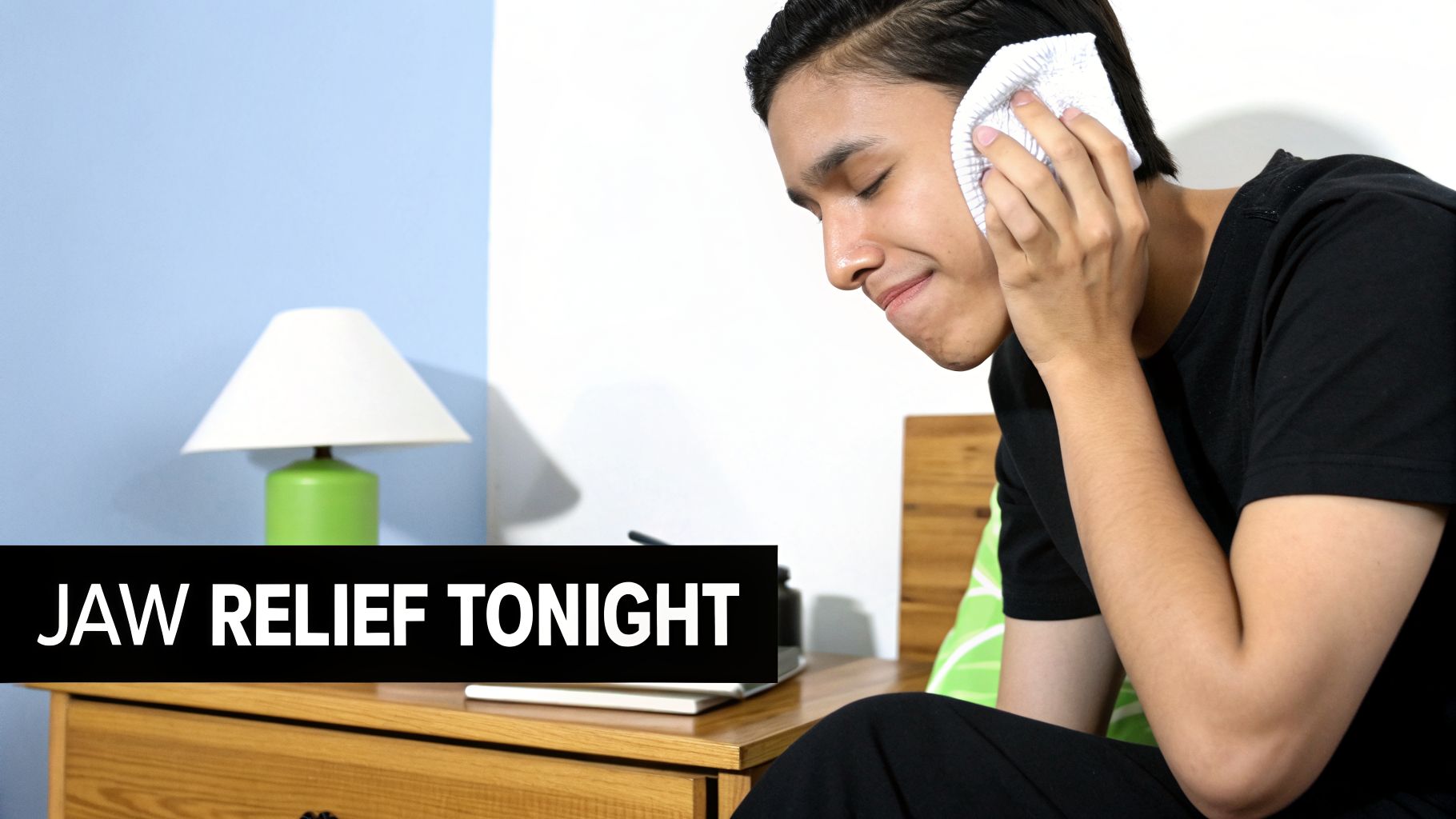
While a professional diagnosis from a dentist near you is the key to a long-term solution, you don't have to wait for an appointment to get some relief. You can take steps tonight to ease jaw tension and reduce the intensity of your grinding.
Think of these strategies as first aid for your overworked jaw muscles—they won't cure the underlying issue, but they can provide immediate comfort and make a surprisingly big difference in how you feel when you wake up.
Soothe Your Jaw Muscles Directly
One of the most effective ways to calm an aching jaw is with simple temperature therapy. Applying a warm, moist compress to the sides of your face is excellent for muscle relaxation. Just run a washcloth under warm water, wring it out, and hold it against your jaw for about 15 minutes before bed. This simple act helps increase blood flow, releasing tension and soothing the ache.
Gentle jaw stretches are also incredibly beneficial. These aren't strenuous exercises but slow, deliberate movements designed to release built-up stress.
- The Gentle Open: Slowly open your mouth as wide as you comfortably can without causing pain. Hold for 5-10 seconds, then slowly close.
- The Soft Side-to-Side: With your mouth slightly open, gently move your lower jaw from side to side. Avoid any sharp or jerky movements.
Repeating these a few times before you even lie down can help convince those tight muscles to let go.
Mindful Practices During the Day
Believe it or not, what you do during the day significantly impacts what happens at night. Many of us clench our jaws when we're focused, stressed, or even just sitting at a desk, which pre-tenses the muscles for nighttime grinding.
Try to be mindful of your jaw's resting position. The ideal posture is with your lips together but your teeth slightly apart. A great trick is to place the tip of your tongue on the roof of your mouth just behind your front teeth; this naturally helps the jaw relax. If you're interested in learning more, we have a helpful guide that explores the connection between mouth guards and jaw discomfort.
The cycle of teeth grinding often begins long before you go to sleep. Daytime clenching, even if subtle, primes your jaw muscles for intense activity at night. Breaking this daytime habit is a powerful step toward a peaceful night's sleep.
Adjust Your Evening Routine
Finally, take a hard look at your habits in the hours leading up to bedtime. Certain substances are notorious for interfering with sleep quality and increasing muscle activity, making bruxism worse.
To give your jaw a fighting chance, it's smart to adjust a few key lifestyle habits.
Lifestyle Adjustments to Help Reduce Nighttime Grinding
This table offers a quick look at common triggers and some simple swaps you can make.
| Habit to Reduce | Potential Impact on Grinding | Helpful Alternative |
|---|---|---|
| Caffeine Intake | Increases muscle activity and can disrupt deep sleep cycles. | Switch to decaf coffee or herbal tea (like chamomile) in the afternoon. |
| Evening Alcohol | Disrupts REM sleep, the stage where grinding is often most severe. | Enjoy a glass of water with lemon or a relaxing, non-alcoholic beverage. |
| Chewing Gum | "Trains" your jaw muscles to stay active and clenched throughout the day. | Opt for a sugar-free mint to freshen your breath instead. |
| Hard or Chewy Foods | Overworks jaw muscles, leading to fatigue and increased tension. | Choose softer foods for dinner, like soup, fish, or steamed vegetables. |
Making these small, intentional changes can provide much-needed relief from the pain and pressure of bruxism, empowering you to take immediate action while you explore professional solutions.
How Professional Dental Solutions Provide Lasting Protection
While at-home strategies can be fantastic for immediate relief from jaw pain and sore muscles, they don't solve the core problem. To truly protect your teeth from the long-term, destructive effects of grinding, you need a professional solution. This is where the expertise of an experienced dentist in Wesley Chapel becomes invaluable.
The most common and effective line of defense is a custom-fitted night guard, sometimes called an occlusal splint. This is worlds away from the bulky, boil-and-bite guards you find at the drugstore. Frankly, those one-size-fits-all options often have a terrible fit, which can be uncomfortable, disrupt your sleep, and in some cases, even make jaw pain worse.
The Superiority of a Custom-Fitted Night Guard
At Seven Oaks Dentistry & Sleep Medicine, we create custom appliances meticulously crafted just for you. With over 30+ years of experience, Dr. Daniels starts by taking precise digital impressions of your teeth. This guarantees your night guard fits perfectly—snug, comfortable, and without getting in the way of a restful night's sleep.
This perfect fit isn’t just about comfort; it's about function. The appliance acts as a powerful barrier between your upper and lower teeth, designed to absorb and distribute the immense forces from clenching and grinding. This kind of protection is crucial for preventing a whole host of serious dental problems that impact your whole mouth health:
- Enamel Wear: Stops the slow, steady erosion of your tooth's protective outer layer.
- Tooth Fractures: Shields your teeth from the intense pressure that leads to cracks and chips.
- Damage to Dental Work: Protects the investment you've made in crowns, veneers, and fillings.
- Jaw Muscle Relief: Allows your jaw muscles to relax into a more natural position, which helps ease soreness.
Addressing the Root Cause Beyond the Guard
In many cases, a night guard is the ideal primary solution. But as a private practice focused on whole-mouth health, we always look a little deeper. Sometimes, bruxism is a red flag for an underlying structural issue with your bite. If your teeth don't line up correctly, it puts your jaw muscles in a constant state of strain, which can trigger grinding.
Here in our Wesley Chapel office, we might recommend other treatments to get to the root of the problem:
- Orthodontic Solutions: For patients with a misaligned bite, treatments like Invisalign clear aligners can be a game-changer. By gradually guiding teeth into their proper positions, we can create a more harmonious bite that often reduces or even stops the grinding reflex.
- Restorative Treatments: If worn, broken, or missing teeth are throwing your bite off balance, restorative dentistry might be the answer. Procedures like crowns or bridges can rebuild your bite’s structure, giving those overworked jaw muscles the stability they need to finally calm down.
A professional evaluation is the only way to know if you're just treating the symptom or actually solving the problem. A custom guard protects your teeth, but fixing a bite issue provides a long-term, functional solution for your complete oral health.
The global prevalence of bruxism is surprisingly high, affecting an estimated 22.22% of people. For busy professionals and families here in the North Tampa area, that means there's a good chance nighttime grinding is silently eroding tooth enamel. Studies have shown that professionally made occlusal splints can reduce jaw muscle activity by 50-70%—a level of effectiveness that going without treatment simply can't match. You can learn more about these clinical findings and see the data for yourself.
Beyond dental appliances, other therapies can bring significant relief. For instance, specific deep tissue massage therapy techniques applied to the facial and neck muscles can provide targeted, immediate relief from the acute pain spots caused by clenching.
Ultimately, protecting your smile requires a personalized approach. At our independently owned dental practice, we take the time to understand your unique situation and recommend a solution that offers lasting protection and peace of mind.
The Critical Link Between Teeth Grinding and Sleep Apnea
If you're trying to figure out how to stop grinding your teeth at night, you’ve probably focused on things like stress or maybe even looked into a simple night guard. But what if the real cause is something much deeper? For many people, obstructive sleep apnea (OSA) is the hidden culprit behind their nighttime grinding.
That jaw-clenching habit might be more than just an annoyance—it could be a serious red flag from your body trying to tell you something is wrong with your whole-body health.
There’s a powerful, proven link between sleep bruxism and OSA. The grinding isn’t just a random habit; it's often a subconscious reflex your body uses as a survival mechanism when your airway gets blocked.
How Sleep Apnea Triggers Grinding
When you have obstructive sleep apnea, the soft tissues in your throat relax and collapse during sleep, cutting off your breathing for seconds or even minutes at a time. This lack of oxygen sends a panic signal straight to your brain.
In a desperate attempt to reopen the airway and get you breathing again, your brain can trigger a powerful, involuntary contraction of your jaw muscles. They clench and thrust forward forcefully.
That violent muscle movement is what we call teeth grinding. In this scenario, the grinding isn't the actual problem—it's a symptom of your body fighting to breathe. This is exactly why a standard, over-the-counter night guard often falls short. It might put a cushion between your teeth, but it does absolutely nothing to fix the dangerous breathing interruptions happening all night long.
This decision tree gives you a great visual of the first steps to take when you notice signs of wear and tear, pointing you toward professional solutions like custom guards or orthodontics.
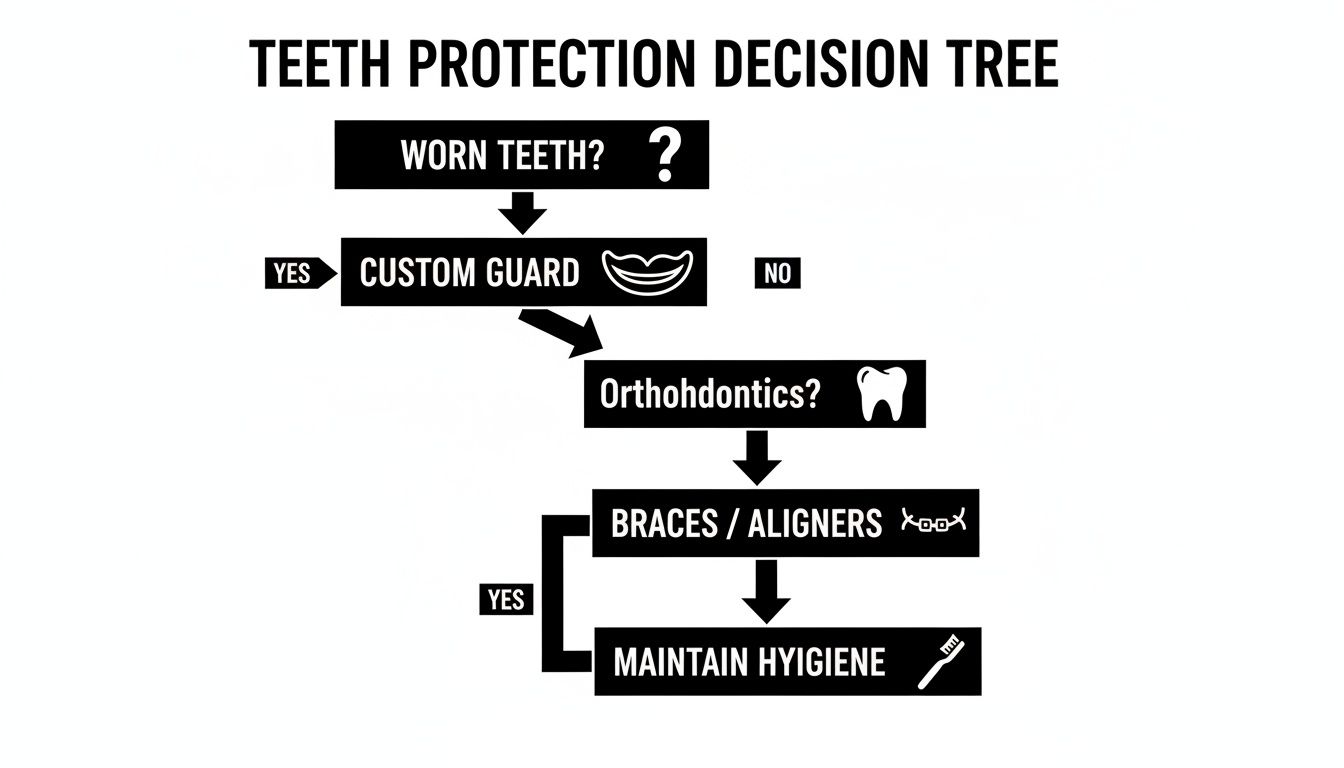
As you can see, identifying tooth wear is the starting point, leading to different but specific professional paths to protect your smile.
An Integrated Approach to Treatment
At Seven Oaks Dentistry & Sleep Medicine, we're uniquely set up to investigate this critical connection because we understand that your oral health and sleep health are two sides of the same coin. A proper evaluation, which might include a sleep study, is the only way to know for sure if your grinding is a sign of a sleep-breathing disorder.
We believe in treating the whole person, and the link between grinding and sleep apnea is a perfect example. Just treating the grinding without checking for an airway issue is like silencing a fire alarm while the building is still on fire. Our goal is to find the root cause and solve it for good.
The data backs this up. Research shows that 25.6% of patients with OSA also deal with sleep bruxism, and that number climbs to 43% in men. This is why having integrated sleep dentistry right here in Wesley Chapel is so important.
An effective oral appliance, like those designed by Dr. Lee Daniels, can reduce grinding episodes by as much as 60%. At the same time, it treats the apnea, giving you two major benefits from one simple device.
Dual-Purpose Solutions for Better Sleep
If sleep apnea turns out to be the root cause of your grinding, we can tackle both issues at once. Instead of a basic night guard, we can create a custom oral appliance that’s specially designed to do two jobs.
First, it protects your teeth from the intense forces of grinding. Second, it's engineered to gently shift your lower jaw forward, a subtle adjustment that keeps your airway open all night. This prevents the apnea events from happening in the first place.
It's a powerful two-for-one solution. You save your teeth from damage while finally getting the deep, restorative sleep your body has been craving. For patients with more severe apnea, understanding how a portable oxygen concentrator works can also be beneficial in managing the condition.
Want to learn more? We break it all down in our guide where you can learn more about how to treat sleep apnea in our detailed article.
Start Your Path to Relief at Our Wesley Chapel Practice
Finding a lasting solution for nighttime teeth grinding really begins with a simple conversation. It’s about connecting with a dental professional who sees the whole person, not just a list of symptoms. When you visit Seven Oaks Dentistry & Sleep Medicine, you’re not just another appointment; you’re a valued member of our Wesley Chapel community, and your well-being is our top priority.
As a private, independently owned practice, we offer an experience that’s becoming harder to find. We believe in unhurried, personalized care where you actually have time to feel heard. Dr. Daniels, with over 30+ years of experience, will sit down with you to listen—really listen—to your concerns, from the morning headaches to the jaw soreness and worn-down teeth.
What to Expect When You Visit Our Wesley Chapel Practice
Your initial consultation is easily the most important part of the journey. This is where we go beyond a quick glance and conduct a thorough evaluation to get the full picture of your oral health. We’ll examine your teeth for signs of wear, check your jaw muscles for tension, and have a real conversation about your sleep patterns and daily stressors.
This in-depth assessment is what allows us to pinpoint the specific factors contributing to your bruxism. Is it a bite alignment issue? A subtle sign of underlying sleep apnea? Or is it primarily driven by stress? Understanding the “why” is absolutely essential before we can recommend the right “how.”
After the evaluation, Dr. Daniels will walk you through all your options in clear, easy-to-understand terms. We’re big believers in patient education, empowering you to make informed decisions for your own health.
- Custom Night Guards: We’ll explain how a professionally crafted appliance provides far superior protection and comfort compared to the one-size-fits-all options you find at the pharmacy.
- Sleep Apnea Solutions: If we suspect a link to a sleep-breathing disorder, we’ll discuss the next steps for a proper diagnosis and treatment with specialized oral appliances.
- Restorative and Orthodontic Options: Should a misaligned bite be the root cause, we can explore how treatments like Invisalign or other cosmetic dentistry can create long-term harmony and relieve the pressure.
Committed to Your Complete Health
Our entire philosophy is built on the principle of complete health. We firmly believe that your oral wellness is deeply and inextricably linked to your overall well-being. Teeth grinding is a perfect example of this connection, often signaling issues with sleep, stress, or airway function that ripple out to affect your entire body.
Choosing a dentist is more than just finding someone to fix your teeth; it's about finding a partner in your long-term health. As a private practice, we are dedicated to building that trusted relationship, offering continuity of care from a team that knows you and your history.
We are committed to helping our neighbors in Wesley Chapel, FL, and the surrounding North Tampa areas find real, lasting relief. You don’t have to accept waking up in pain as your new normal. There are effective, modern solutions available, and it all starts by taking that first step.
If you are tired of the cycle of jaw pain, headaches, and damaged teeth, we invite you to experience the difference that dedicated, patient-centered care can make. Discover what it feels like to be treated in a welcoming environment where your health is the singular focus. Let's work together to find the right path toward peaceful nights and healthier, pain-free days.
Ready to take control of your sleep and protect your smile? Schedule your consultation with Seven Oaks Dentistry & Sleep Medicine today and start your journey toward relief. Visit us at https://dentistwesleychapel.com to book your appointment.
 Read Our Reviews

 October, 2026

