
So, you’re starting your Invisalign journey in Wesley Chapel, FL. One of the first questions almost everyone asks is, "How long will it take to get used to these things?" It's a common concern, and understanding the process can help reduce any anxiety you might have.
The short answer? Most people feel completely comfortable with their Invisalign aligners within one to two weeks. That initial feeling of pressure or awkwardness is totally normal—and it’s a great sign that your teeth are already on the move toward a healthier, straighter smile, contributing to your whole-body health.
Your Invisalign Adjustment Timeline in Wesley Chapel
Let's walk through what you can expect, from the first few hours to the moment your aligners feel like a natural part of your day. This initial adjustment period is a small but important first step in your overall treatment.
At Seven Oaks Dentistry & Sleep Medicine, we guide our Wesley Chapel families through every stage of the process. As a private practice dentist with over 30 years of experience, Dr. Daniels designs treatment plans that not only deliver incredible results but also prioritize your comfort. We’re here to make your path to a new smile as smooth as possible, right here in our independently owned dental practice.
The First 72 Hours: The Pressure Phase
When you pop in that first set of aligners, you’ll immediately feel a snug, gentle pressure on your teeth. This is exactly what’s supposed to happen! It means the aligners are already hard at work, beginning the healing process through the mouth.
Think of it like the mild soreness you feel after a good workout—it’s a sign that positive changes are underway. This pressure is most noticeable when you take the aligners out to eat or drink.
Week One: Adapting to Your New Routine
By the end of the first week, that initial intense pressure should start to fade. Now, you might notice a few other temporary quirks. Some people develop a slight lisp or find themselves producing a bit more saliva than usual.
Don't worry—this is just your mouth's natural reaction to having something new in it. These little side effects are temporary and usually disappear as your tongue and cheeks get used to sharing space with the aligners. This is a normal part of achieving comprehensive care.
This visual timeline breaks down the key milestones of your first two weeks, from initial pressure to routine comfort.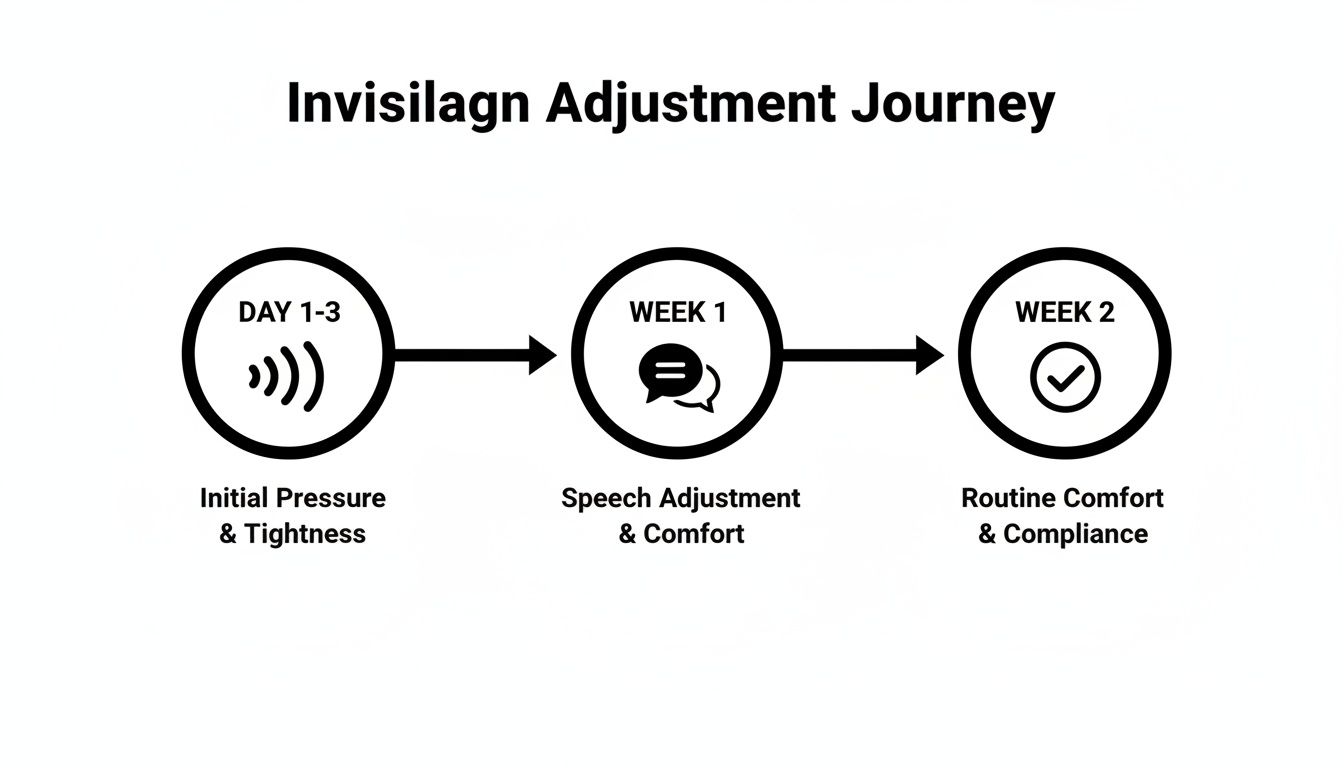
As the infographic shows, the journey quickly moves from initial awareness and minor speech changes to becoming an unnoticeable part of your daily life.
Week Two: Finding Your Groove
By the second week, you’re hitting your stride. For most patients, the aligners have become a seamless part of their day. Taking them in and out for meals and brushing is now second nature. The initial soreness is a distant memory, and you're well on your way.
Here’s a simple table to show you what that adjustment process looks like week by week.
Your Week-by-Week Invisalign Adjustment Timeline
| Timeframe | What to Expect | Comfort Level |
|---|---|---|
| Days 1–3 | Noticeable pressure and tightness on your teeth. Mild soreness, especially when removing aligners. | Low to Moderate |
| Days 4–7 | Pressure subsides. You may notice a temporary lisp or extra saliva as your mouth adapts. | Moderate |
| Week 2 | Aligners feel much more natural. Taking them in and out is easy. Any speech changes have likely disappeared. | High |
| Ongoing | A brief period of pressure for 1-2 days with each new set of trays, but the adjustment is much faster. | Very High |
This rapid adjustment is one of the best parts of the Invisalign system.
Based on patient feedback and clinical studies, the vast majority of people adapt fully within the first 1-2 weeks. In fact, around 85-90% of patients report feeling little to no discomfort by day 14.
Of course, this adjustment timeline is just the first step. The total time you'll spend in treatment depends on your unique smile goals. To get the bigger picture, check out our complete guide on how long Invisalign takes from start to finish.
What to Expect During Your First Few Weeks

Starting your Invisalign journey is an exciting first step toward the smile you’ve always wanted. But what does “getting used to” your new aligners actually feel like? Knowing what to expect can make those first couple of weeks much easier and keep you feeling positive about the process.
The sensations you’ll feel are all part of your smile’s transformation, a key component of complete health. Understanding why they happen is the key to navigating them with confidence. At Seven Oaks Dentistry & Sleep Medicine, we believe an informed patient is a happy one, and our team is always here to support you.
Understanding Tooth Soreness
The most common thing you’ll notice is a feeling of pressure or mild soreness in your teeth, especially during the first 24 to 72 hours after putting in a new set of aligners. This isn't just normal—it's a great sign!
That gentle, consistent force is what guides your teeth into their new, healthier positions. Think of it as a clear signal that your treatment is working exactly as planned. This feeling usually fades after a few days as your teeth settle into the new tray, improving your whole mouth health with each step.
Temporary Speech Changes
You might also find yourself with a slight lisp or a minor change in your speech when you first start wearing your aligners. Your tongue is simply used to having a certain amount of space, and that super-thin layer of SmartTrack™ material can temporarily get in the way.
Don't worry—this is one of the quickest side effects to disappear. Most people find their speech is back to normal within a week as their tongue adapts. It’s the kind of real-world insight we share at our private practice right here in Wesley Chapel.
To speed things up, try reading aloud, singing along to your favorite songs, or just talking a bit more than usual. This "practice" helps your tongue get acquainted with the aligners faster, making any speech changes very short-lived.
Managing Other Minor Adjustments
It's also pretty common to produce more saliva at first. This is just your mouth’s natural reaction to having something new in it. Just like the speech changes, this feeling typically goes away within a few days once your body gets used to the aligners.
Here are a few other things you might notice:
- A "Tight" Feeling: Every new tray will feel snug. That's because it’s designed for where your teeth are going, not where they are right now.
- Awareness of Attachments: If your treatment includes small, tooth-colored "attachments," you might feel them against your cheeks or lips initially. A small piece of orthodontic wax can provide relief if they cause any irritation.
These experiences are a small, temporary part of a process that contributes to your complete health and a confident smile. At our family-owned dental practice in Wesley Chapel, FL, Dr. Daniels' 30+ years of experience ensures your treatment is planned for maximum comfort and effectiveness right from day one.
Factors That Influence Your Adjustment Period
Ever wonder why your friend seems to be sailing through their Invisalign journey while you’re still getting the hang of it? The truth is, getting used to your aligners isn't a one-size-fits-all experience. A few key factors shape how quickly you adapt, making your journey as unique as your smile itself.
Your personal comfort level and the complexity of your orthodontic treatment both play a huge part. But the single biggest factor influencing how fast you adjust is compliance. If there’s one secret to a smoother experience, it’s consistently wearing your aligners for the recommended 20-22 hours a day.
Your Unique Treatment Plan
The specific movements your teeth need to make will naturally influence how everything feels. A treatment plan designed to close a simple gap will feel much different from one correcting more complex bite issues. For example, minor crowding adjustments often lead to a faster adjustment period compared to significant rotations or bite corrections.
Here at our independently owned practice, Dr. Daniels draws on his 30+ years of experience to map out a treatment plan that minimizes discomfort right from the start. This careful approach ensures our patients in Wesley Chapel and North Tampa receive care designed specifically for their needs, not a generic template.
Age and Case Complexity
Age and the intricacy of your case also play a role. Generally, younger patients may find their mouths adapt to the aligners a bit more quickly. Adults, particularly those with more complex alignment problems or bite issues, might take a little longer to feel completely comfortable.
Our experience at Seven Oaks Dentistry & Sleep Medicine shows that for adults in North Tampa, those with milder cases often feel comfortable in about 6-10 days. However, those with more significant bite issues may need up to three weeks to fully adapt. You can explore more on how case complexity impacts Invisalign timelines and find additional insights on the topic.
Think of it like training for a marathon. The more consistent you are with your running schedule, the faster your body adapts and gets stronger. The same principle applies to your Invisalign aligners. Daily dedication is what makes the process smooth and successful.
Your Personal Sensitivity
Everyone has a different tolerance for pressure and discomfort. What one person describes as mild pressure, another might feel more acutely. This is completely normal—it’s just a reflection of your body's individual response to the forces moving your teeth.
Knowing this can help you set realistic expectations. A little soreness is a sign that things are working, but the feeling itself is unique to you. At Seven Oaks Dentistry & Sleep Medicine, we make this a priority, ensuring our recommendations are always centered on your personal experience. This patient-first philosophy is a cornerstone of our private practice.
Expert Tips for a Comfortable Invisalign Transition
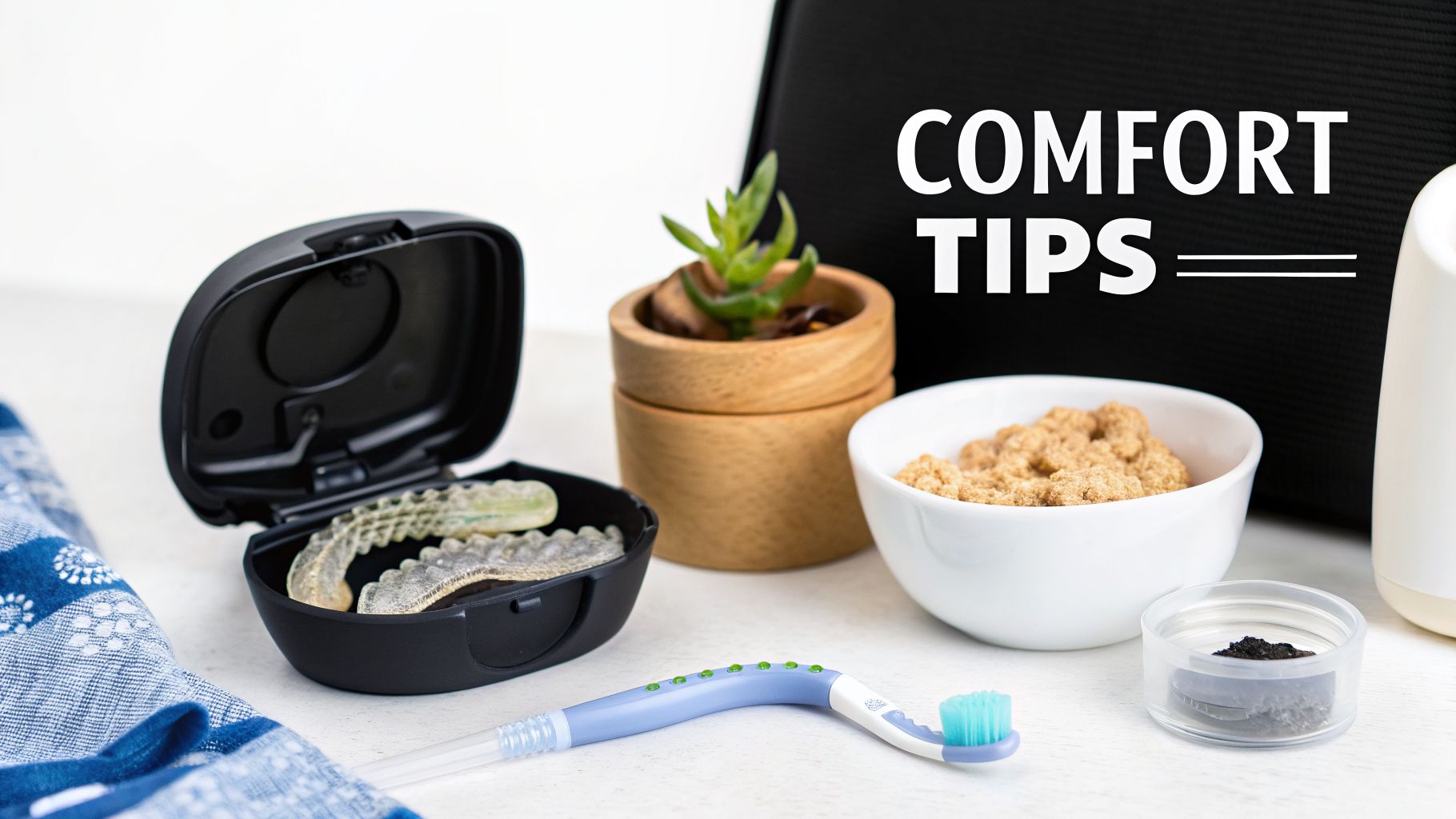
The good news is, you don’t have to just white-knuckle it through the adjustment period. There are simple, effective ways to make your transition to clear aligners much smoother and help your mouth adapt faster. These tips come straight from our experienced team at Seven Oaks Dentistry & Sleep Medicine and are designed to bring you real relief.
Being proactive is the key. Small tweaks to your daily routine can make a huge difference in how you feel during those first few days with a new set of trays. Our goal is to provide mouth health education that gives you the tools and knowledge to manage your comfort with confidence.
Ease Into It With Softer Foods
One of the easiest ways to dial down the discomfort is to stick to a soft-food diet for the first day or two after putting in a new aligner. Your teeth will be at their most sensitive during this initial window, and chewing hard, crunchy, or sticky foods can really ramp up that feeling of pressure.
Try to fill your plate with options like:
- Smoothies and yogurt
- Soups and broths
- Mashed potatoes
- Scrambled eggs and oatmeal
This temporary diet change gives your teeth and jaws a much-needed break while they get used to the new aligner. It’s a simple strategy that pays off big time in comfort.
Use “Chewies” to Seat Your Aligners and Relieve Pressure
Aligner “chewies” might look like simple little foam rolls, but they’re a powerful tool in your Invisalign toolkit. These small, soft cylinders are made of a spongy material called styrene copolymer, and biting on them for a few minutes each day serves two critical purposes.
First, it helps fully seat your aligners, making sure they have a snug, perfect fit against your teeth. This is vital because a well-seated aligner can apply pressure exactly where it needs to, keeping your treatment on track. Second, that gentle chewing motion actually increases blood flow around your tooth roots, which many patients find helps to soothe soreness.
At Seven Oaks Dentistry & Sleep Medicine, we see tools like these as part of a bigger picture. A well-seated aligner simply works better, and anything that improves comfort makes the entire journey to a healthier smile more positive for our Wesley Chapel patients.
Maintain Excellent Oral Hygiene
This tip is about so much more than just having fresh breath; it’s fundamental to your comfort and health. When food particles get trapped between your aligners and your teeth, it becomes a breeding ground for plaque, which increases your risk for cavities and gum irritation. And irritated gums can become more sensitive, adding to the discomfort you might already be feeling.
- Brush and floss after every single meal before you pop your aligners back in.
- Clean your aligners daily just as our team instructs.
Keeping your mouth impeccably clean is a cornerstone of our philosophy that whole body health starts at the mouth. A clean mouth is a comfortable mouth. If you want a deeper dive, you can find a ton of helpful advice in our guide to life with clear aligners.
When to Use Orthodontic Wax
Every once in a while, the edge of a new aligner might feel a little sharp or rough against your tongue or the inside of your cheek. If you notice a specific spot that’s causing irritation, a small dab of orthodontic wax can be a lifesaver. Just pinch off a tiny piece, warm it between your fingers to make it pliable, and press it onto the aligner edge that’s bothering you. It creates a smooth, comfortable barrier and provides immediate relief.
To make things even easier, we've put together a quick summary of these comfort strategies.
Tips for Invisalign Comfort
| Tip | How It Helps | Best Time to Use |
|---|---|---|
| Stick to Soft Foods | Reduces pressure and soreness on sensitive teeth. | The first 1-2 days of a new aligner tray. |
| Use “Chewies” | Seats aligners properly and increases blood flow to relieve soreness. | For a few minutes, several times a day. |
| Practice Good Hygiene | Prevents plaque buildup and gum irritation, which can worsen discomfort. | After every meal and snack, without fail. |
| Apply Orthodontic Wax | Creates a smooth barrier over any sharp edges on the aligner. | Anytime you feel a specific spot of irritation on your cheeks or tongue. |
Following these simple tips can dramatically improve your experience, especially during the first few days with each new set of aligners. By taking a proactive approach, you can focus less on discomfort and more on the exciting transformation your smile is undergoing.
How Invisalign Supports Your Complete Health Journey
Starting your Invisalign journey is about so much more than getting a picture-perfect smile. It's a powerful investment in your long-term, whole-body health. At Seven Oaks Dentistry & Sleep Medicine, we see orthodontics as a key pillar of our “healing through the mouth” philosophy. The link between your oral health and overall wellness is direct and undeniable.
Straightening your teeth isn't just a cosmetic dentistry upgrade. Think about it: properly aligned teeth are far easier to brush and floss effectively. This dramatically lowers your risk of plaque buildup, gum disease, and cavities. By creating a healthier mouth, you're taking a proactive step to prevent problems that can echo throughout your entire body.
A Foundation for Whole-Body Wellness
A corrected bite does more than just improve your smile's appearance. It can also relieve chronic issues you might not have even realized were tied to your dental alignment. For many of our patients here in Wesley Chapel, FL, a balanced bite reduces jaw pain, tension headaches, and the premature, excessive wear on their teeth.
But it goes deeper. The alignment of your jaw has a direct impact on your airway, creating a natural bridge to our practice’s focus on sleep apnea and sleep medicine. For some people, correcting bite issues can contribute to better breathing and more restful sleep—a cornerstone of complete health that we are uniquely positioned to address.
As a private practice dentist with 30+ years of experience, Dr. Daniels evaluates how orthodontics fits into your entire health profile. We don’t just see a set of teeth; we see a whole person whose well-being starts at the mouth.
Personalized Care Beyond Cosmetics
This holistic view is the hallmark of our independently owned dental practice in Wesley Chapel. We believe in being a true partner in our community's long-term wellness, not just a provider of quick cosmetic fixes. Your Invisalign treatment plan is designed with your complete health in mind, considering how every small adjustment supports better function and reduces future health risks.
Choosing Seven Oaks Dentistry & Sleep Medicine means choosing a team that understands these critical connections. We are dedicated to providing mouth health education that empowers you to see your treatment as a foundational step toward a healthier, more vibrant life.
Begin Your Invisalign Journey in Wesley Chapel
The path to a healthier, more confident smile is often much shorter and easier than people imagine. As you weigh your options, it's smart to explore the various new teeth straightening options available today. Invisalign really stands out for its comfort and convenience, and that initial adjustment period is just a small, totally manageable step in the process.
Remember, the dedicated team at Seven Oaks Dentistry & Sleep Medicine will be with you at every turn. When you choose a private practice dentist like Dr. Daniels, you're getting personalized, compassionate care from an experienced local dentist with over 30 years of experience right here in the Wesley Chapel and North Tampa area.
Your comfort and confidence are our top priorities. At our independently owned practice, we don't just straighten teeth—we build lasting relationships and guide our patients toward complete health and wellness.
If you're ready to see how clear aligners can improve your oral and overall health, we invite you to take that next step. Our patient-focused approach ensures your journey is fully supported, from your first question about how long to get used to Invisalign all the way to your final, beautiful result.
Contact us today to schedule your consultation and discover if Invisalign is the right choice for you. We look forward to welcoming you to our Wesley Chapel practice and helping you achieve the healthy, functional smile you deserve.
Common Questions About Getting Used to Invisalign
Here are a few more specific questions our patients in Wesley Chapel often ask when starting their Invisalign journey. At Seven Oaks Dentistry & Sleep Medicine, we believe that knowing what to expect is key to a confident and successful treatment.
Will I Have a Lisp with Invisalign Forever?
Absolutely not. It's very common to have a slight, temporary lisp when you first start wearing your aligners. This happens simply because your tongue is adjusting to having something new in your mouth and a slightly smaller space to move around in.
For most people, normal speech comes back within a few days to a week. A great tip to speed this up is to practice! Try reading a book aloud or just talking a bit more than usual. This helps your tongue adapt much faster. If you’re still concerned after a week, just let our experienced dentist know.
Is It Normal for Some Teeth to Feel More Sore Than Others?
Yes, this is completely normal—and it’s actually a great sign! Your Invisalign aligners are carefully designed to apply precise, targeted pressure to specific teeth at each stage of your treatment.
The teeth that are scheduled for the most movement with a particular tray will naturally feel the most pressure. When you feel that targeted soreness, it means the treatment is working exactly as Dr. Daniels planned, moving you one step closer to a healthier, more functional bite and contributing to your complete health.
What if My New Aligner Tray Doesn't Seem to Fit?
Each new set of aligners is supposed to feel snug and tight at first. That's a good thing! The aligner is shaped for where your teeth are going, not where they are right now. This intentional pressure is how the magic happens.
Using your “chewies” for a few minutes each day is a fantastic way to help seat the aligner correctly and close any tiny gaps between the tray and your teeth. However, if a tray feels truly ill-fitting or causes any sharp, unusual pain, please don't ever try to force it. Contact our Wesley Chapel office right away so we can help.
Can I Drink Coffee with My Aligners In?
We strongly recommend drinking only cool, clear water while wearing your aligners. There are two big reasons for this. First, hot drinks like coffee or tea can actually warp the medical-grade plastic, which could change the aligner’s fit and make your treatment less effective.
Second, colored beverages like coffee, tea, and red wine will stain your aligners, making them much less “invisible.” It's always best to pop your aligners out for all food and drinks (other than water) to protect your investment and keep your treatment on track.
Ready to begin your journey to a healthier, more confident smile? The team at Seven Oaks Dentistry & Sleep Medicine is here to guide you every step of the way. Schedule your consultation today.
 Read Our Reviews

 October, 2026

