
If you're searching for fl dental implants because you're tired of hiding your smile, chewing on one side, or worrying that one missing tooth is turning into a bigger problem, you're not alone. Many people in Wesley Chapel put this decision off for months or even years because they feel nervous, embarrassed, or unsure whether implants are really worth it.
I understand that hesitation. When a tooth is missing, the problem rarely stays limited to the space you can see in the mirror. The bite can shift. The jawbone can begin to change. Meals become less enjoyable. Confidence often takes a hit long before someone says it out loud.
That’s why I like to explain dental implants in plain language. A calm, informed patient usually feels much more comfortable taking the next step.
Understanding Dental Implants and Your Overall Health
You notice the gap when you smile, but your body notices more than the space in the mirror. A missing tooth changes how you chew, how your bite meets, and how the jawbone is used each day. For some patients in Wesley Chapel, it even starts a chain reaction that affects food choices, comfort, sleep quality, and confidence.
A dental implant rebuilds the missing tooth from the foundation up. The implant post is placed in the jawbone where the root used to be. An abutment connects that post to the final crown, which is the custom tooth you see above the gums. Each part has a job, and together they restore structure as well as appearance.

Why a missing tooth affects more than your smile
The jaw works a bit like muscle. It stays stronger when it is being used the way nature intended. Tooth roots help deliver that pressure into the bone during chewing. When a root is gone, the bone in that area can begin to shrink over time.
That foundation is one reason implants stand apart from choices that replace only the visible part of the tooth. Because an implant sits in the bone, it helps maintain the support system under the gums. Research summarized by the American Academy of Implant Dentistry explains that dental implants are designed to replace missing tooth roots and support the bone and surrounding oral structures in this overview of how implants function.
A stable bite supports daily life in practical ways. Chewing feels more balanced. Speech is clearer. Cleaning around the area is more straightforward. Meals become less of a negotiation.
That matters for whole-body health. Patients who are missing teeth may start avoiding foods that require real chewing, including crisp vegetables, lean proteins, and other foods that support energy and healing. If you want a clearer picture of that connection, how oral health affects overall health explains why problems in the mouth can influence nutrition, inflammation, and general wellness.
Why more adults are choosing implants
Implants have become a familiar part of modern dentistry because tooth loss is common across adult age groups. Many people are surprised to learn how early this conversation can start. The CDC reports that adults age 20 to 64 have an average of 24.9 remaining permanent teeth, which means partial tooth loss is not rare according to national oral health data.
Patients tend to like implants for three simple reasons:
- They look natural. The crown is shaped and shaded to fit your smile.
- They feel anchored. The support comes from the jawbone, not from putting extra strain on neighboring teeth.
- They restore real function. You are replacing a working part of the mouth, not just covering a gap.
The mouth and body connection
As a dentist, I do not see an implant as a stand-alone fix. I see it as part of a larger plan to restore stability. Your mouth guides how you chew, swallow, speak, and rest your jaw. When a tooth is missing, the body starts adapting, and those adaptations are not always healthy.
That broader view matters at Seven Oaks Dentistry and Sleep Medicine because oral health and airway health can intersect. A collapsed bite, worn teeth, clenching, and poor oral stability can exist alongside sleep-disordered breathing in some patients. An implant does not treat sleep apnea, but rebuilding a healthy, stable mouth can be part of understanding the bigger picture of your health.
A simple way to think about fl dental implants
A bridge replaces the visible gap by attaching to nearby teeth. A denture replaces teeth above the gums. An implant replaces the missing tooth in the place where support begins.
For many patients, that difference changes everything. The goal is not only to fill a space. The goal is to restore comfort, protect the jaw, support better function, and help you feel like yourself again.
Determining Your Candidacy for Dental Implants
One of the first questions people ask is, “Am I even a candidate?” That’s a fair question, and the answer usually isn’t a quick yes or no. It’s a careful evaluation of your mouth, your health history, and your treatment goals.
Many patients assume implants are only for people with perfect teeth and perfect health. That’s not how real dentistry works. Candidacy is about whether we can create the right conditions for success.
What dentists look for
The key issue is support. An implant needs enough healthy bone and healthy gum tissue around it to remain stable over time. Good home care matters too, because the implant has to be maintained just like the rest of your mouth.
A clinician will usually assess several factors:
- Bone availability: Is there enough jawbone in the area to hold an implant securely?
- Gum health: Active periodontal disease may need treatment first.
- Bite forces: Your bite has to be evaluated so the implant isn’t overloaded.
- Medical factors: Conditions like diabetes or smoking history may affect healing and planning.
Practical rule: A complicating factor doesn't always rule out implants. It often means the treatment plan needs to be more thoughtful.
Why imaging matters
Modern diagnostics make a big difference. A standard exam tells part of the story. A CBCT scan gives a three-dimensional view of the jaw, nearby anatomy, and available bone. That helps dentists plan implant placement more precisely and avoid guesswork.
If bone volume is limited, it doesn't always mean treatment stops there. In some cases, bone grafting may create a stronger foundation first. If you want a clearer understanding of that process, this explanation of what bone grafting for dental implants involves is a useful next read.
Common concerns patients bring up
People often lower their voice when they ask these questions, as if they expect bad news.
“I’ve had gum problems before.”
“I clench my teeth.”
“I’ve been missing this tooth for a long time.”
“I’m not the easiest dental patient.”
Those concerns are important, but they’re also common. A good implant workup is meant to uncover those issues early so they can be addressed. Sometimes the path is straightforward. Sometimes it involves phased care, such as gum treatment, extraction healing, or bone support before implant placement.
A simple comparison can help:
| Concern | What it may mean |
|---|---|
| Missing tooth for a long time | Bone may have changed, so imaging becomes especially important |
| Gum disease history | Tissues may need to be stabilized before implant treatment |
| Medical condition | Healing may need closer monitoring |
| Dental anxiety | Comfort options and slower pacing may improve the experience |
The right question to ask
Instead of asking, “Do I qualify?” a better question is, “What would need to happen for implants to work well for me?”
That shift matters. It turns the process from judgment into planning. For many nervous patients in Wesley Chapel and North Tampa, that’s the moment things start to feel possible again.
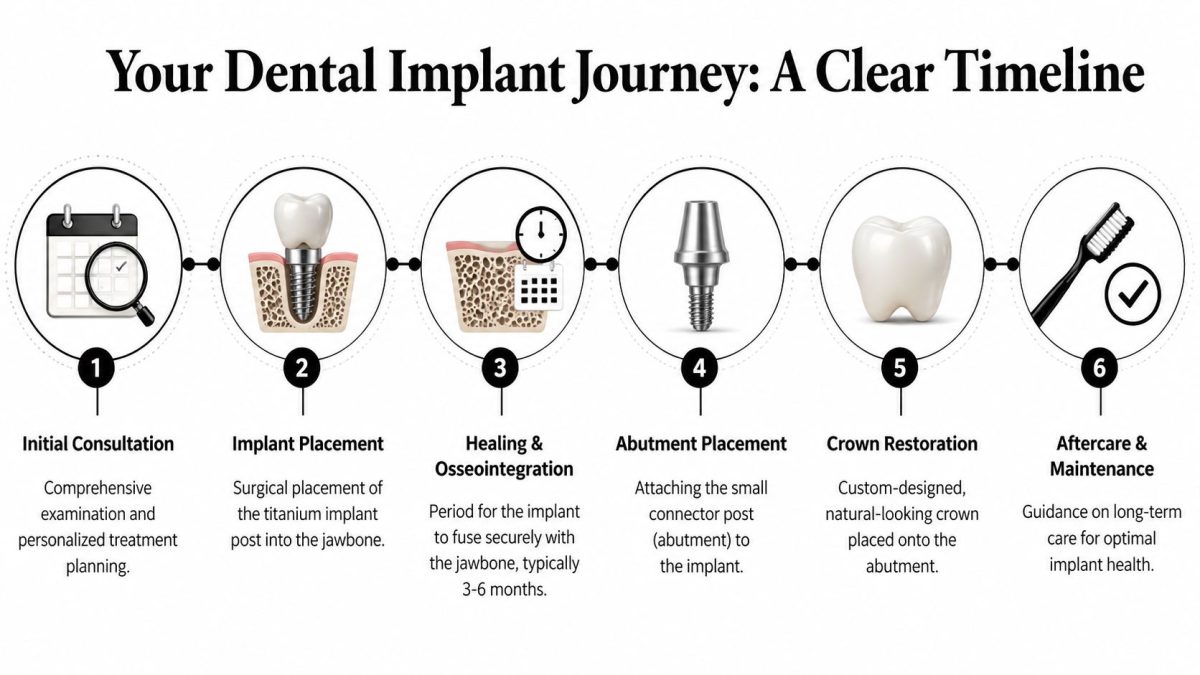
Your Step-by-Step Dental Implant Treatment Timeline
Understanding what comes next can bring comfort. The implant process sounds intimidating when it’s described as surgery in one sentence. It feels much more manageable when you understand the sequence.
Consultation and planning
The first visit is usually a listening visit as much as a dental one. You talk about what happened, what bothers you now, and what you want your smile and bite to feel like in the future. Photos, X-rays, and often a 3D scan help build the plan.
This stage matters because implant treatment should be driven by the final result, not just by the empty space. The dentist has to think about where the crown will sit, how your bite comes together, how much bone is present, and whether anything needs to happen first.
The day the implant is placed
For many patients, this is the part they fear most. In reality, implant placement is often less dramatic than they imagined. The area is numbed thoroughly, and comfort measures can be discussed in advance for anyone with anxiety.
The implant itself is placed into the jawbone with careful planning and controlled technique. Some systems used in Florida implant centers rely on dynamic navigation with real-time 3D tracking fused with CBCT imaging, allowing placement deviations of less than 0.5 mm linear and less than 3° angular accuracy, according to this technology overview describing X-GUIDE. Patients don’t need to memorize those details. What matters is the practical takeaway. Better planning and placement precision can support a smoother, more predictable procedure.
The goal on surgery day isn't speed. It's control, comfort, and accuracy.
Healing and osseointegration
After the implant is placed, your body does the quiet work. Bone gradually bonds to the implant surface in a process called osseointegration. That’s what gives the implant its long-term stability.
Healing doesn’t feel exciting, but it’s one of the most important phases. You’ll usually be given instructions about diet, cleaning, and follow-up visits. If a temporary tooth is appropriate, that will be discussed ahead of time. If not, the focus stays on protecting the site while it matures.
A simple timeline looks like this:
- Planning: Records, imaging, and treatment design
- Placement: The implant post is positioned in the bone
- Healing: The bone integrates with the implant
- Connection phase: The abutment is attached
- Final tooth: The crown or restoration is seated
- Maintenance: Regular care keeps the implant healthy
The final restoration
Once the implant has integrated well, the restoration phase begins. A small connector called an abutment is secured, and then the custom crown is made to fit your bite, shape, and smile.
At this stage, patients often feel an emotional shift. Up until then, the process may have felt clinical. Once the final tooth is in place, it starts to feel personal again. You can see the change. You can test your bite. You can speak and smile without focusing on what’s missing.
What everyday life feels like afterward
Recovery varies from person to person, but many patients are surprised that the process feels more like a series of manageable appointments than one overwhelming event. The timeline may be different if you need grafting, extraction, or a full-arch solution, but the structure is similar.
What helps most is having a clear roadmap and a team that explains what’s normal. When patients know what’s happening and why, they usually feel more in control.
Lasting Benefits of Dental Implants for Your Health and Confidence
You may notice the benefit of an implant on a very ordinary day in Wesley Chapel. You sit down for dinner, chew without shifting everything to one side, speak without tracking the gap in your smile, and laugh without that quick flash of self-consciousness. That kind of relief reaches further than appearance. It supports comfort, nutrition, confidence, and in some cases, the broader health concerns we also watch closely in a sleep-focused dental practice.
Modern implants demonstrate a 95% to 98.8% success rate, and long-term studies report 20-year success rates of 85% to 95% according to this Florida dental implant guide.

They restore daily function
A missing tooth can change habits so gradually that the change barely registers at first. Many people start chewing on the opposite side, passing on firm foods, or choosing meals based on what feels safe instead of what sounds good. After enough time, the workaround becomes routine.
An implant helps rebuild balance in the bite because it replaces the missing tooth at the root level, not just at the gumline. A table with one short leg can still hold a plate, but it never feels steady. Your bite works in a similar way. When support returns where it belongs, chewing can feel more even, speech can feel clearer, and meals become less stressful.
They support appearance without looking artificial
A well-planned implant is designed to blend into your smile in shape, color, and contour. The goal is for it to look like your tooth, not like dental work.
The emotional part of that change is real. Many people searching for fl dental implants are trying to stop thinking about the missing space every time they talk, smile, or pose for a photo. Once that constant awareness fades, people tend to feel more present in daily life.
Some patients say the hardest part of tooth loss isn't chewing. It's the constant awareness that something is missing.
If worry about your teeth has stayed with you in unusual ways, it can help to explore the symbolism of teeth falling out dreams. Resources like that can put words to fears about health, appearance, change, and loss of control. Those feelings are common in the dental chair, even if patients rarely say them out loud at first.
They support long-term oral and whole-body health
An implant is not a magic fix for every dental problem, but it can protect more than a smile. Because the implant sits in the bone where the root used to be, it helps preserve the structure that supports your mouth over time. That foundation matters for bite stability and for keeping neighboring teeth from carrying extra strain.
At Seven Oaks Dentistry and Sleep Medicine, we also look at the bigger picture. If a patient has worn teeth, jaw strain, airway concerns, or signs that poor sleep is affecting oral health, implant planning should fit into that full health conversation. Replacing a tooth is one part of the work. Supporting comfortable function, healthier habits, and confidence in your day-to-day life is the larger goal.
For many people, the lasting value includes:
- Stronger chewing ability: Meals feel less restricted and more comfortable.
- Bone support: The implant helps maintain structure in the area of the missing root.
- Smile confidence: Attention shifts away from the gap and back to the conversation.
- Long-term durability: An implant is designed to serve as a stable replacement, not a short-term patch.
A visual explanation can make these benefits easier to picture.
Confidence changes everyday life
Confidence affects far more than photos. It shapes how freely you speak, laugh, eat with friends, and participate at work or with family. Patients frequently tell me they did not realize how much energy they were spending managing a missing tooth until they no longer had to think about it.
That is why implants can feel so meaningful. They restore function in the mouth, and they also help people feel more like themselves again.
Understanding the Cost of Dental Implants in Florida
A common Wesley Chapel conversation starts like this: “Dr. Daniels, I know I need to replace this tooth. I’m just worried I won’t be able to afford it.”
That concern is real, and it deserves a clear answer. Implant treatment is a health decision and a financial one. If you have been putting off care because the price feels hard to understand, you are not alone.
In Florida, implant costs are often discussed in the $3,000 to $5,000 per tooth range, and many residents do not have dental coverage, according to Florida’s discussion of care access and the FRAME program. A consultation matters because your actual cost depends on your mouth, your goals, and whether treatment needs to support larger concerns such as bite stability, damaged teeth, or sleep-related airway issues.
Why the price can differ from one patient to another
Dental implants work like rebuilding a house from the foundation up. One person may need only the new support post and the final visible tooth. Another may need site preparation first so the result is stable and healthy.
That is why there is no single fee that fits everyone.
Several details shape the total cost:
- How many teeth are being replaced: One implant is very different from several implants or a full-arch plan.
- Bone and gum health: Some patients need grafting or other preparatory care before an implant can be placed safely.
- The final restoration: A crown, bridge, or full set of implant-supported teeth changes the treatment scope.
- Planning and imaging: Detailed diagnostics help your dentist place the implant with accuracy and protect nearby structures.
Cost makes more sense when you look at the whole health picture
Patients often ask about price first, but value matters just as much. A missing tooth can affect chewing, place extra stress on nearby teeth, and make some people avoid certain foods. In some cases, changes in bite and oral function can also be part of a larger pattern that includes jaw strain, tooth wear, and poor sleep.
That bigger picture matters at Seven Oaks Dentistry and Sleep Medicine. If implant treatment can restore a missing tooth while also helping create a healthier, more stable mouth, the conversation becomes larger than a single line item on a treatment estimate.
A helpful way to compare options: Ask what each option is likely to cost your health, comfort, and confidence over the next several years, not only what it costs this month.
Questions to ask during a financial discussion
Clear financial conversations help patients feel calmer. You should know what is included, what could change, and what support may be available before treatment begins.
| Question | Why it helps |
|---|---|
| What is included in my treatment estimate? | Clarifies whether exams, imaging, implant placement, and the final restoration are all part of the fee |
| Will treatment happen in phases? | Helps you understand timing and whether costs may be spread out |
| Will insurance contribute to any part of care? | Identifies benefits for exams, extractions, imaging, or restorations |
| Do you offer financing or payment options? | Makes planning easier for many families |
If you or a family member are sorting through public coverage before deciding on care, this guide to understanding Medicaid dental benefits may help you organize the right questions to ask.
Talking about affordability is part of good care
Many patients feel awkward bringing up money in a dental office. You do not need to feel that way. A thoughtful practice expects those questions and should answer them with respect.
The goal is simple: a personalized plan with real numbers, clear phases, and honest guidance. That gives you something much better than a rough internet estimate. It gives you a practical path toward better health, stronger function, and renewed confidence.
Why Wesley Chapel Chooses Seven Oaks for Dental Implants
Choosing where to have implant treatment is about more than finding someone who offers the procedure. It’s about deciding who you trust to evaluate your health, explain your options clearly, and carry out treatment with judgment. That matters even more when you're anxious, short on time, or trying to balance oral health with larger concerns like sleep, comfort, and long-term wellness.
In Wesley Chapel and surrounding areas in Northern Tampa, many patients are looking for something increasingly specific. They don’t want rushed, one-size-fits-all care. They want a private office where they’re known, where treatment recommendations are explained in plain English, and where the dentist sees the mouth as part of the whole body.
Experience changes the quality of decisions
Dr. Lee Daniels brings over 30 years of experience to patient care. Experience matters in implant dentistry not because it makes appointments feel formal, but because it improves clinical judgment.
An experienced dentist knows when a case is straightforward and when it needs a slower, more protective plan. He knows when a patient’s anxiety is the main barrier, when bite forces deserve extra attention, and when the right answer is to stabilize the mouth first. That kind of judgment doesn’t come from a brochure. It comes from decades of treating real people with different medical histories, expectations, and concerns.
A private practice feels different
Patients usually notice the difference quickly. A private office tends to offer more continuity, more conversation, and more room for individualized planning. You’re less likely to feel like you’re moving through a system designed around volume.
That’s important with implants because so many details have to line up well. The missing tooth is only one part of the picture. The condition of the gums, the shape of the smile, the way the upper and lower teeth meet, and the patient’s comfort level all influence the final outcome.
At Seven Oaks Dentistry and Sleep Medicine, patients can receive extensive care under one roof, including restorative planning, implant restoration, broader oral health support, and sleep-related dental care. That’s useful when someone needs a coordinated plan rather than isolated appointments.

Technology supports precision, but it doesn't replace judgment
Patients often hear terms like digital scanning, CBCT, and guided surgery without knowing what they change. In practical terms, technology helps the dentist see more clearly, plan more accurately, and perform treatment with better control.
For implant cases, advanced imaging can show bone contours, neighboring structures, and restorative space before treatment begins. Navigation and digital design can help align the implant position with the final tooth, not just the hole in the bone. That planning mindset reduces surprises and supports a more predictable result.
A few practical advantages stand out:
- Better visibility: Three-dimensional imaging can show anatomy that standard views may miss.
- More precise planning: Implant position can be chosen with the final bite and restoration in mind.
- Smoother communication: Patients often feel less anxious when they can see the plan visually.
- Safer sequencing: Pre-treatment issues are easier to identify before surgery day.
Dental care and sleep health often overlap
This is one area many patients don’t expect, but it matters. The mouth isn’t separate from breathing, airway support, and sleep quality. For some adults, tooth loss, bite collapse, clenching, and oral anatomy all interact with nighttime symptoms.
That doesn’t mean every implant patient needs sleep treatment. It does mean a dentist who pays attention to airway and sleep health may catch issues that would otherwise be missed. If a patient has sleep apnea, poor sleep, heavy grinding, or jaw instability, those details can influence restorative planning.
Restoring teeth and restoring comfort often go together. The best plan looks at how you chew, breathe, sleep, and function as one system.
This whole-health perspective can be especially reassuring for adults who’ve felt that prior dental care focused only on isolated teeth. In a more integrated setting, the conversation can include function, facial balance, airway concerns, and daily quality of life.
Comfort matters more than people admit
A large number of patients considering implants are also managing some level of fear. Sometimes that fear comes from a difficult past experience. Sometimes it comes from the idea of oral surgery itself. Sometimes patients feel overwhelmed by how much treatment they may need.
That’s why comfort measures and communication style matter so much. A calm pace, clear explanations, and appropriate sedation options can change the entire experience. For anxious patients, being heard is often as important as being treated.
What patients usually want is simple:
- They want honesty. No pressure, no jargon, no confusion.
- They want a plan. Clear steps reduce fear of the unknown.
- They want comfort. Anxiety shouldn’t be treated like a personality flaw.
- They want lasting results. If they’re investing in their health, they want it done thoughtfully.
Why local matters in ongoing implant care
Implants aren’t a one-day transaction. They involve evaluation, planning, placement, restoration, and maintenance. Being treated close to home in Wesley Chapel can make that process easier for busy families and working adults in Northern Tampa.
Local care also supports follow-up. If you have questions during healing, want your bite checked, or need long-term maintenance, it helps to return to a familiar office where your records, imaging, and treatment goals are already understood.
That continuity matters. Dentistry works best when the provider knows your history, not just your appointment slot.
The bigger reason patients move forward
An implant consultation isn’t typically scheduled out of a sudden interest in dentistry. Rather, it occurs because something in everyday life isn’t working anymore. Individuals are tired of avoiding certain foods. They’re frustrated by a removable tooth. They don’t like how the gap looks when they laugh. They’re starting to realize the problem won’t improve on its own.
The right office helps turn that frustration into a plan. Not a sales pitch. A plan.
When that plan is built around experience, careful diagnostics, a private-practice relationship, and a broader view of total health, patients tend to feel more confident moving forward. And confidence matters. It often makes the difference between postponing care again and finally taking action.
If you're ready to talk through your options for fl dental implants in Wesley Chapel and nearby Northern Tampa communities, schedule a consultation with Seven Oaks Dentistry and Sleep Medicine. You’ll get a clear evaluation, straightforward guidance, and a treatment conversation centered on your health, comfort, and long-term goals.
 Read Our Reviews

 October, 2026

