
When you hear the words "first molar root canal," it's natural to feel a little overwhelmed. But turning that anxiety into confidence is all about finding the right dental partner—someone you can trust to put your comfort and whole-body health first. At Seven Oaks Dentistry & Sleep Medicine, we are that partner for families all over Wesley Chapel, FL, and the surrounding Northern Tampa communities.
Your Wesley Chapel Partner For Complete Dental Wellness

Facing any kind of dental work, especially on a tooth as important as a first molar, brings up a lot of questions. Who can you count on for precise, comfortable care that lasts? In Wesley Chapel and the Northern Tampa area, that answer makes a huge difference in your treatment and your peace of mind.
Unlike large, impersonal dental chains, Seven Oaks Dentistry & Sleep Medicine is a privately owned practice. This isn't just a small detail; it's the foundation of how we care for our community. Here, you’re not just a number on a chart. You’re our neighbor, and your health is our top priority because we believe that healing through the mouth contributes to whole-body wellness.
The Value Of a 30+ Years Experience Dentist in a Private Practice
At the heart of our practice is Dr. Lee Daniels, a dentist with over 30 years of dedicated experience. When you're dealing with the complex anatomy of a first molar, that level of expertise is exactly what you want. Dr. Daniels has handled countless restorative procedures, delivering care that isn't just clinically excellent but is also gentle and reassuring. A great dentist knows how to use effective strategies to improve patient satisfaction, making sure you feel heard and comfortable from your first consultation through your recovery.
Choosing an independently owned dental practice like ours comes with real advantages:
- Continuity of Care: You'll see the same friendly, trusted team every time you visit. We get to know you, your family, and your unique dental history.
- Personalized Attention: We take the time to listen. We'll sit down, provide clear mouth health education, answer all your questions, and create a treatment plan that fits your specific needs and goals.
- Patient-First Decisions: Our recommendations are based on one thing: what's best for your long-term health. We’re free from corporate quotas or pressure to upsell.
Connecting Oral Health To Whole-Body Health
Here at Seven Oaks Dentistry & Sleep Medicine, we are dedicated to the principle that complete health starts in the mouth. A first molar root canal is so much more than a procedure to save a tooth—it's a critical step in eliminating infection and restoring balance to your entire body.
This is a core part of our commitment to comprehensive care. We understand the deep connection between your oral health and your overall wellness. By treating the source of the pain and infection in your molar, we’re not just saving your bite; we’re helping your body thrive. This philosophy is woven into everything we do, from family dentistry and Invisalign to cosmetic dentistry and sleep apnea solutions. We are here to be your partner on the journey to a healthier smile and a healthier you.
Why Your First Molar Might Need a Root Canal
Ever wonder why first molars seem to be a common site for dental trouble? These teeth are the workhorses of your mouth, handling most of the chewing. But their position and job description also make them vulnerable to problems that often lead to a first molar root canal.
Your first molars are typically the first permanent teeth to arrive, usually around age six. That means they’ve been on the job longer than almost any other tooth, grinding and crushing food day in and day out. Over decades, this constant pressure can lead to tiny cracks and wear, giving bacteria a pathway deep inside the tooth.
Understanding why these specific teeth are so susceptible helps reframe a root canal from something intimidating into a logical, necessary step to heal and save your tooth. This is central to our ‘whole mouth health’ philosophy here at Seven Oaks Dentistry & Sleep Medicine—fixing one crucial tooth helps keep your entire oral system stable and functional.
The Problem with Their Anatomy and Location
The shape of a first molar is another key factor. These are large teeth with deep, complex grooves on their chewing surfaces. While great for mashing up food, these crevices are also perfect traps for food particles and plaque, making them hard to clean and a prime spot for deep cavities to form.
If that decay isn't treated early, it can work its way through the tooth's tough outer enamel and dentin layers, eventually reaching the soft pulp tissue inside. This pulp is the tooth's living core, filled with nerves and blood vessels. Once infected, it can cause severe pain and even lead to a dental abscess, making a root canal the only way to relieve your pain and save the tooth from being pulled.
Recognizing the Warning Signs
Your body is pretty good at letting you know when a first molar is in distress. Ignoring these signals can lead to a more severe infection and more pain, so it’s important to listen to what your mouth is telling you.
Here are the key signs that your first molar’s pulp might be infected or inflamed:
- Lingering Pain to Hot or Cold: If sensitivity to temperature lasts for more than a few seconds after a sip of coffee or a bite of ice cream, that’s a classic red flag.
- Sharp Pain When Biting Down: This often means the infection has started to affect the tissues around the tooth's root.
- Swollen or Tender Gums: A small, pimple-like bump (known as an abscess) on the gums near the tooth is a sure sign of infection.
- A Dull, Constant Ache or Spontaneous Pain: Pain that starts on its own, especially if it's bad enough to wake you up at night, points to a serious problem.
At Seven Oaks Dentistry & Sleep Medicine, we see these symptoms often in our Wesley Chapel patients. Getting it checked quickly is critical, because an untreated infection can spread and impact your overall health, highlighting that vital link between your mouth and your body.
It's also worth noting that sometimes an infected tooth shows no symptoms at all. The problem is only discovered during a routine dental X-ray, which is one more reason why regular check-ups with your local dentist are so important for your complete health.
Interestingly, needing a root canal is far from rare. A massive global review found that about 8.2% of all teeth examined had received root canal treatment, and an estimated 55.7% of people have at least one tooth that's been treated. While modern preventive care has helped, this shows how often this tooth-saving procedure is needed. You can discover more insights about these dental statistics and what they mean for public health. Knowing this helps normalize the procedure and shows that if you need one, you're definitely not alone.
The Unique Anatomy of a First Molar
A root canal on a front tooth is worlds apart from a first molar root canal. The reason? It all comes down to a surprisingly complex anatomy.
A front tooth is like a simple, single-lane road. A first molar, on the other hand, is a major highway interchange, complete with multiple lanes and hidden tunnels you’d never know were there.
This complexity is exactly why successfully treating a first molar requires deep understanding and years of hands-on experience. It’s not just about cleaning a tooth; it’s about navigating a microscopic, three-dimensional maze. At Seven Oaks Dentistry & Sleep Medicine, Dr. Daniels' 30+ years of experience is your greatest asset, ensuring every curve and canal is meticulously cleaned and sealed for long-term health.
These teeth are the workhorses of your mouth, and all that grinding and chewing takes a toll. This is why molars are so prone to problems.
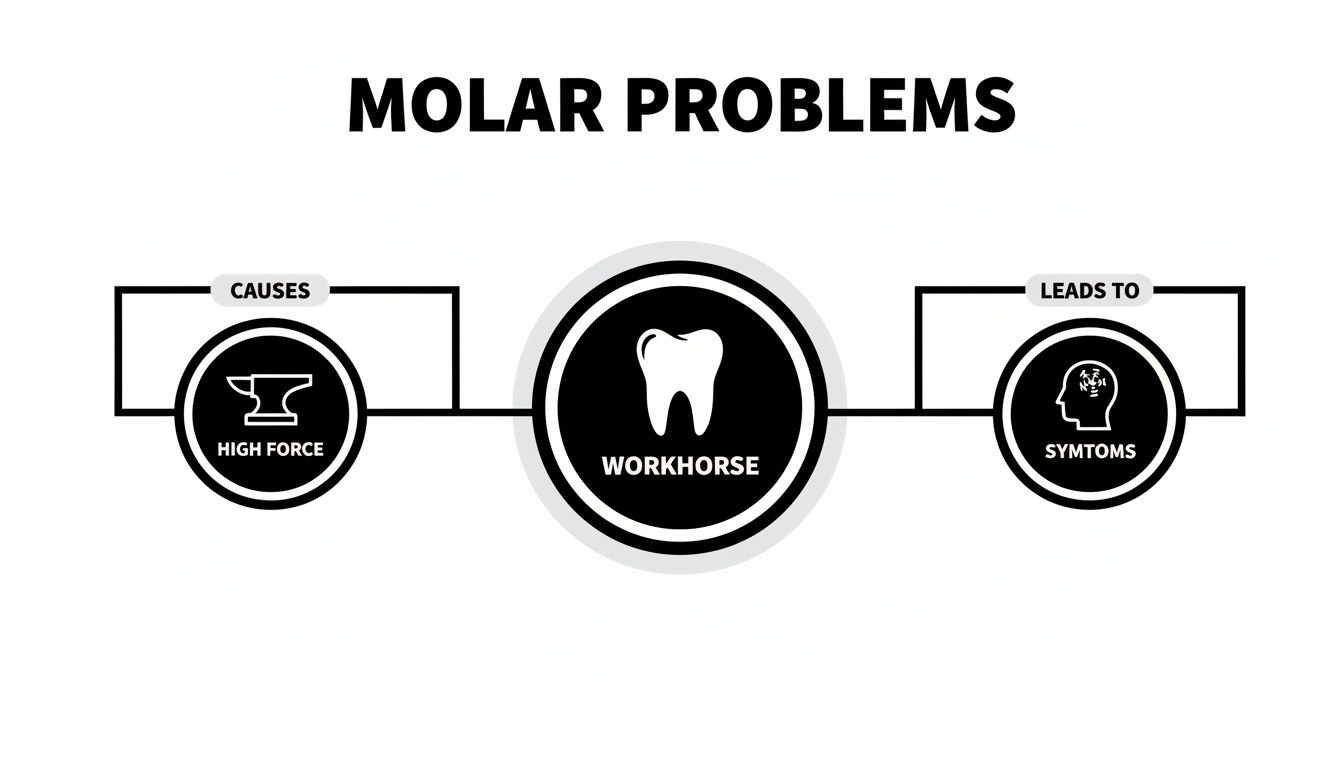
The direct connection between a molar's function, the forces it withstands, and the pain that follows underscores why these teeth often need an expert’s touch.
The Challenge of Upper First Molars
The upper (maxillary) first molars are notorious in the dental world, mainly because they often hide a tiny, extra canal.
Most of these molars have three roots. For years, the common belief was they had three canals—one for each root. But with advanced imaging and microscopes, we've learned a different story.
One of the main roots, called the mesiobuccal root, frequently contains a second, hard-to-find canal known as the MB2. If this canal is missed during a root canal, bacteria get left behind, leading to persistent infection and, ultimately, treatment failure. Finding and treating the MB2 is a hallmark of a thorough, high-quality root canal performed by an experienced dentist.
The presence of this "hidden" canal isn't a rare anomaly. Worldwide analyses show that maxillary first molars hide an MB2 canal in a staggering 73.8% of cases. An experienced dentist knows to look for it every single time, because leaving it untreated is a primary cause of failed root canals.
In fact, the prevalence of this tricky fourth canal varies globally, appearing in 78.8% of cases in Iceland and 74.4% in Italy. Detailed studies also show that even the main canals have their own complex networks of smaller, accessory canals. This anatomical puzzle is why a dentist's skill and attention to detail are paramount. You can read the full research about these molar complexities to see just how intricate these teeth are.
The Variability of Lower First Molars
Lower (mandibular) first molars present their own unique set of challenges. While they typically have two large roots, the canal systems inside those roots can be wildly unpredictable.
Instead of simple, round canals, they often feature strange, ribbon-shaped or C-shaped canals, which are much tougher to clean and shape properly. Some lower molars might even have an extra third root, a trait more common in certain populations.
This variability means a dentist can't rely on a one-size-fits-all approach. Each tooth must be assessed individually, often with advanced 3D imaging, to map out its specific anatomy before treatment even starts. This commitment to precision is a core part of our comprehensive care philosophy at our Wesley Chapel office. We understand that what we do inside your tooth directly impacts your whole-body health by eliminating infection at its source.
Here’s a quick look at how the common anatomical challenges stack up between upper and lower first molars.
Upper vs. Lower First Molar Root Canal Challenges
| Anatomical Feature | Upper First Molar (Maxillary) | Lower First Molar (Mandibular) |
|---|---|---|
| Primary Challenge | The "hidden" MB2 fourth canal is present in over 70% of cases and can be easily missed. | Canal shape is often irregular, with C-shaped or ribbon-like systems that are difficult to clean. |
| Number of Roots | Typically has three separate roots. | Typically has two roots, but a third root can sometimes be present. |
| Canal Complexity | Canals are often curved and narrow, especially the MB2. | Canals can connect or split unpredictably deep within the root. |
Understanding this complex anatomy isn't meant to cause alarm. Instead, it highlights why choosing the right dental team is so important. For a procedure as delicate as a first molar root canal, you want a private practice dentist like Dr. Daniels, whose experience ensures they're prepared for any anatomical surprise your tooth might hold.
Your Root Canal Procedure Step-by-Step
Knowing what actually happens during a first molar root canal can make all the difference, turning anxiety into confidence. At Seven Oaks Dentistry & Sleep Medicine, we’re committed to making complex procedures feel straightforward and manageable. We’ll walk you through every phase so you know exactly what to expect.
The journey starts well before treatment day. It begins with a careful diagnosis, where Dr. Daniels uses advanced imaging to get a crystal-clear map of your molar’s unique anatomy. This detailed planning means we can tackle the procedure with absolute precision, ready for any surprises your tooth might have in store.
Ensuring Your Complete Comfort
Our first and most important job on the day of your procedure is making sure you are completely comfortable and won't feel a thing. Modern dentistry has truly transformed the once-feared root canal into a routine, pain-free experience.
We start by applying a topical numbing gel to your gums. Once that takes effect, Dr. Daniels will administer a local anesthetic to completely numb the tooth and all the surrounding tissue. You might feel a tiny pinch, but the area will quickly become profoundly numb, guaranteeing you won't feel any pain during the treatment.
For our Wesley Chapel patients who feel nervous about dental work, we also offer sedation dentistry options. These solutions help you relax on a deeper level, making the entire appointment feel calm and peaceful. Your well-being is our top priority.
The Treatment Process Unveiled
Once you’re fully numb and relaxed, the root canal can begin. The whole process is meticulous and focused on one main goal: to remove the infected tissue and save your natural tooth.
Here’s a simple breakdown of what we do:
Creating an Access Point: We first place a small rubber sheet, called a dental dam, around the molar to keep it perfectly clean and dry. Dr. Daniels then makes a tiny opening in the crown of the tooth to get to the pulp chamber inside.
Cleaning the Canals: Using highly specialized, delicate instruments, we carefully remove the infected or inflamed pulp from the chamber and each root canal. This is the most crucial part—it eliminates the source of your pain and infection for good.
Shaping and Disinfecting: Next, the canals are shaped and cleaned with a disinfecting solution that flushes out any leftover bacteria. This step ensures the inside of your tooth is completely sterile.
Sealing the Tooth: Once the canals are clean and dry, they’re filled with a biocompatible, rubber-like material called gutta-percha. This seals the canals entirely, preventing bacteria from ever getting back in.
To finish, we place a temporary filling in the opening to protect the tooth until you come back for your permanent crown. The entire procedure is a perfect example of how modern dental care can gently solve a serious problem while keeping your natural tooth right where it belongs.
We want our patients to know that a root canal isn’t about causing pain—it’s about relieving it. The procedure is designed to stop a severe toothache and save a tooth that would otherwise have to be pulled. It’s a healing treatment from start to finish.
This focus on saving teeth is at the heart of what we do at Seven Oaks Dentistry & Sleep Medicine. By treating the infection, we’re not just fixing one tooth; we’re protecting your overall health. To learn more, check out our in-depth look at root canal therapy to preserve your natural teeth at Seven Oaks Dentistry.
What to Expect After Your Root Canal Treatment
The root canal is done, the infection is gone, and the source of that nagging pain has finally been handled. So, what’s next? The recovery period is when your body gets to work healing, and knowing what to expect makes the whole process smoother and more successful.
At Seven Oaks Dentistry, we give our Wesley Chapel patients a clear roadmap for what comes after the procedure. The first few days are about letting your body do its thing. It's completely normal to feel some mild tenderness or sensitivity in the area as the anesthetic wears off, but this is usually manageable with over-the-counter pain relievers.
Immediate Aftercare and Comfort
Your comfort is our top priority. Once your first molar root canal is complete, we'll send you home with specific instructions. The main goal is to protect the treated tooth and give the surrounding tissues a chance to calm down.
A few practical tips can make a huge difference in those first couple of days:
- Stick to Soft Foods: For a little while, you'll want to enjoy foods like yogurt, smoothies, mashed potatoes, and soup. This avoids putting unnecessary pressure on your healing molar.
- Avoid Chewing on That Side: Give the treated tooth a break. Try to chew on the opposite side of your mouth until it’s permanently restored with a crown.
- Maintain Oral Hygiene: You can, and should, keep brushing and flossing. Just be gentle around the treated area to keep it clean, which is crucial for good healing.
This initial recovery phase doesn't last long. Soon enough, you'll be ready for the final, and most important, step in making sure that tooth is strong for the long haul.
Why a Dental Crown is Essential for Your Molar
One of the most common questions we hear is, "If you fixed the tooth, why do I need a crown?" This is a great question, and it's especially critical when we're talking about a first molar root canal. A root canal is fantastic at cleaning out the infection, but it leaves the tooth hollowed out and, frankly, much more brittle than it was before.
Think of it this way: a healthy molar is like a solid oak tree, strong and resilient. After a root canal, that tree is still standing, but it’s now hollow on the inside. A strong gust of wind—or in this case, the incredible force of chewing—could easily cause it to crack or split.
A dental crown acts like a protective helmet for your treated molar. It covers the entire tooth, holding it together and absorbing the powerful chewing forces. This reinforcement is what restores the tooth's strength and allows you to eat and smile with complete confidence again.
Without a crown, a root-canaled molar is at an extremely high risk of fracturing. A bad fracture often means the tooth can't be saved and has to be pulled. Placing a crown is the single best way to protect your investment and ensure your tooth lasts a lifetime. This final step is a perfect example of our approach to comprehensive restorative dentistry—we don’t just fix the immediate problem; we ensure a durable, functional result that supports your overall oral health.
Your Wesley Chapel Partner in Complete Health Dentistry
Making the decision to save a molar with a root canal is a big one. But it’s about more than just a single tooth—it’s an investment in your long-term health. Here at Seven Oaks Dentistry & Sleep Medicine, we look at every procedure, including a first molar root canal, through the lens of complete health dentistry. We know that a healthy mouth is the gateway to a healthy body.
We're a private, independently owned dental practice in Wesley Chapel, which means we’re not beholden to corporate quotas. Our focus is squarely on building lasting relationships with our patients throughout the Northern Tampa community and tailoring our care to your individual health goals.
Experience That Makes a World of Difference
Navigating the tiny, complex canals inside a molar isn't something you want to leave to chance. It takes a steady hand and years of real-world experience. Dr. Lee Daniels brings over 30 years of expertise to every procedure, ensuring even the most challenging cases get the meticulous attention they deserve. The tricky anatomy of a lower first molar, for instance, absolutely demands this level of skill.
The anatomy of lower molars is notoriously variable. Studies show that a significant percentage have four canals instead of the typical three, with numbers varying from 21.6% to 59% depending on the population. Missing one of these tiny canals is a leading cause of root canal failure, which is why an experienced dentist is your best ally. You can learn more about these molar complexities and their findings to understand why expertise matters so much.
Connecting Your Smile to Your Overall Wellness
Our commitment to your health doesn't just stop at one tooth. An infection that requires a root canal can create ripple effects throughout your body if it's not taken care of. By eliminating that infection at its source, we’re actively supporting your systemic health and preventing bigger problems down the road.
This whole-body approach is woven into everything we do, whether it's restorative dentistry like a root canal, cosmetic dentistry to give you back your confidence, or even sleep apnea treatment to improve your rest and vitality. We look at the whole picture to make sure your dental care supports your total well-being.
If you’re dealing with tooth pain or have been told you need a root canal, we invite you to see what a difference personalized, patient-first care can make. Contact Seven Oaks Dentistry & Sleep Medicine in Wesley Chapel, FL, to schedule your consultation today. Let us be your partner in achieving a healthy, pain-free smile for life.
Your Top Questions About Molar Root Canals, Answered
Knowledge is the best tool for easing dental anxiety. Here, we answer some of the most common questions our patients in Wesley Chapel ask about getting a first molar root canal. Our goal is to give you clear, reassuring answers so you feel confident and informed about your care.
Is a Molar Root Canal Painful?
This is the number one question we hear, and the answer might surprise you: no. The whole point of a root canal is to relieve pain, not cause it. Thanks to modern anesthetics and Dr. Daniels' gentle technique, the procedure itself should feel no different than getting a regular filling.
The real pain comes from the infection before the treatment. Once we remove that infected tissue, the source of your severe toothache is gone for good.
How Long Does the Procedure Take?
A root canal on a molar is more complex than on a front tooth, so it naturally takes a little longer. Most first molar root canals at our Wesley Chapel office are completed in a single visit, usually lasting between 60 to 90 minutes.
We take our time to be incredibly thorough. We want to ensure every canal is perfectly cleaned and sealed to give you the best possible long-term result. Your comfort and the quality of our work are always our top priorities.
Why Does My Tooth Need a Crown Afterwards?
After a root canal, the tooth is no longer "alive" and becomes more brittle over time. Think about the massive chewing forces your molars handle—without a crown, the treated tooth is at high risk of fracturing. A bad fracture could mean the tooth has to be pulled.
Think of a dental crown as a protective helmet. It covers the entire tooth, restoring its strength and shielding it from the pressures of daily use. This final step is absolutely essential for protecting your investment and ensuring your molar lasts a lifetime.
What Happens If I Don't Get a Root Canal?
Ignoring an infected molar won't make the problem disappear. In fact, it will only get worse. The infection can spread, leading to severe pain, a dental abscess, and swelling that can travel to your face and neck. Eventually, the infection will destroy the bone around the root, and the tooth will have to be extracted anyway.
Choosing a root canal is a proactive step. It saves your natural tooth, protects your jawbone, and eliminates a dangerous infection from your body, which is a huge win for your overall health.
Ready to put an end to tooth pain and get the expert care you deserve? As Wesley Chapel's trusted, private practice dentist with over 30 years of experience, Seven Oaks Dentistry and Sleep Medicine is here to help. Schedule your consultation today and let us restore your comfort and your smile.
 Read Our Reviews

 October, 2026

